A tremble of Goldfinches

The collective noun for Finches is a Charm, but for Goldfinches they can be called a Charm or a Tremble.

At this time of the year you will see goldfinches in small flocks and their flight is undulating as they search for dead thistle heads and teasel to feed on, in fact their song is a murmur and their flight is like a tremble, we associate goldfinches with teasel as they are the only finch that has a beak able to reach into the teasel to get the seeds.

Most of our Goldfinches will have moved to Southern Europe for the Winter but there are still quite a few about this time of the year around about 100,000 birds compares to over 300,000 breeding pairs in the Spring and Summer.

European goldfinches are brightly coloured birds with a bright red faces and yellow wing patches,  are about 12–13 cm long and will weigh 14 to 19 grams. many were kept in captivity for their song and colour, in fact one of my earliest memories as a child was seeing a goldfinch in a cage in Ireland outside a cottage, it did make me sad then and still does now.

But I am always happy to see them in my garden feeding on the nyger seed I hang out for them a charm more than a tremble I think.

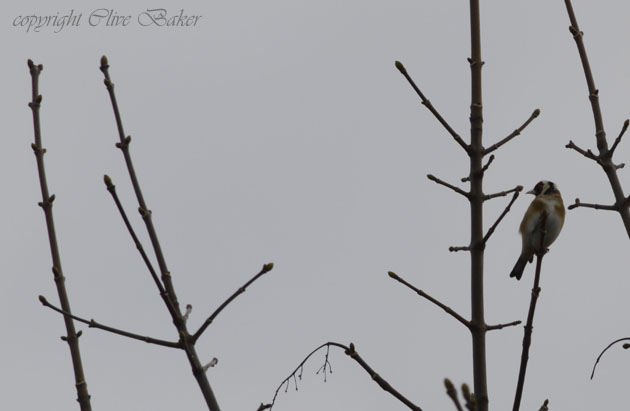
Small goldfinch in tree

Goldfinch brightens up a Winter’s day

Muriel’s Meadow

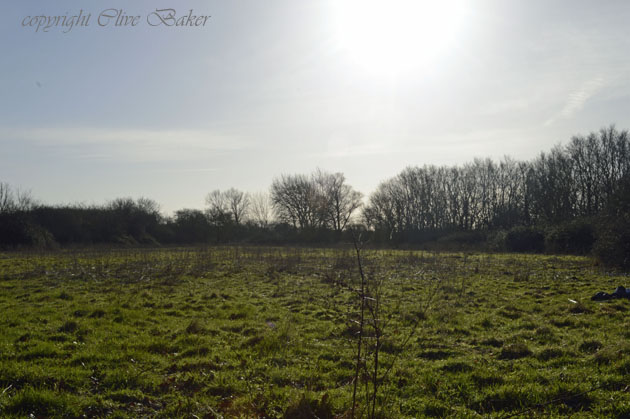
Today was quite a busy day, started early with a work party and some conservation work on a meadow managed by the Wildlife Trust, Muriel’s meadow is one a several meadows that make up Chettisham meadows near Ely, not ploughed as the soil was too heavy, although Chettisham Meadow which is owned by the Wildlife trust shows evidence of medieval ridge and furrow, so obviously ploughing was tried.

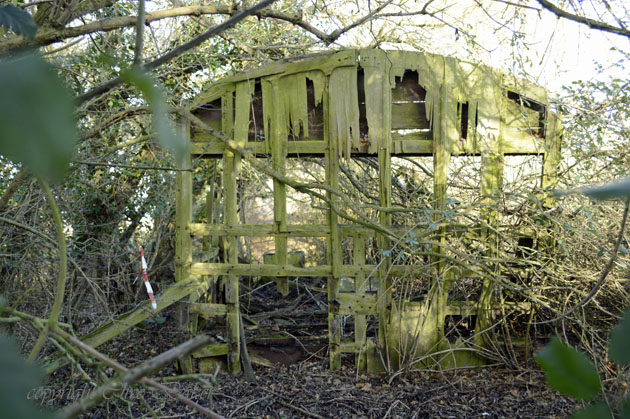
Muriel’s Meadow is named after the lady who used to live there in an old railway carriage as a child with her parents, life must have been very hard and basic as it is at least 20 minutes walk from any road then it must be at least four miles to Ely. The railway carriage is still there but is in a very bad condition but I believe Muriel is still alive and she has asked the carriage is not removed.

grass meadow

View of Muriel’s Meadow

Old railway carriage is disrepair

The Old Railway carriage where Muriel lived with her parents

It was a fantastic bright and sunny morning and there was still ice on the puddles, the birds were singing and our job was to start clearing back the brambles by about 2 feet  so plants can grow back, we will eventually over time clear the brambles back but by doing it gradually it gives plants a chance to establish.

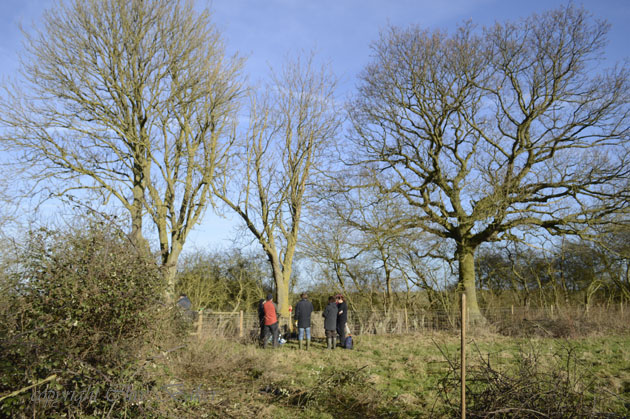
Standing by the big trees

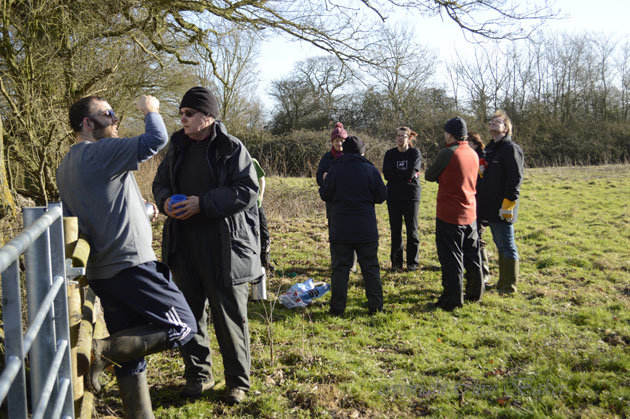
Time for a break and tea

Goupr standing round drinking tea

A well-earned brew and a chat after clearing the brambles

The can be nothing better than working outside on such a wonderful Winters day.

Next It was off to Welney and taking the hare walk and then the swan feed and talk, full number of people booked on the walk, then the largest number of people for the swan talk at 150 in the observatory, so many in fact I had to go out again and do another feed so those at the back got a chance to see what I do.

All in all a very satisfying day.

River Chickens

So I took my Camera to work with me today as we have been seeing kingfishers every day, some quite dramatic and close sightings as they plunge in the water after sticklebacks.

But today we only got fleeting sights of one as it flew down the stream in front of us, maybe it was because it was cold and there was still some ice on the water.

But one bird you can always see near water is the Moorhen a member of the rail family, sometimes known as Marsh hens, River chickens and Waterhens which maybe is the most descriptive of these birds as really you do not find them on moors but always near water, males were known as Water cocks and females known as Water hens.

They always look a nervous bird flicking their tails as they walk, they have large feet that are not webbed, but help them walk over floating vegetation, in fact they also can be seen in trees which always looks quite odd as you do not expect to see them walking along branches.

Moorhen showing front red and yellow beak

Close up of a moorhen

Quite an attractive bird, with its yellow legs and yellow and red beak, but often overlooked as there are estimated to be 270,000 breeding pairs in the United Kingdom.

Moorhen standing in water

Moorhen showing its yellow legs and can just make out its feet under water.

Learn the History understand the Landscape

Last evening I went to see Francis Pryor the guy who discovered Flag Fen, author of non fiction books Britain BC series & The Making of the British Landscape, and now Time Team archaeologist. His latest book is fiction which is new venture into crime.

A really enjoyable evening and I must say I came away thinking more about our East Anglian Landscape, being East Anglian born and bred I am passionate about our landscape, OK it does not have mountains, has a few undulating hills, but we have the biggest skies and largest areas of wetland habitat than most of the British Isles, but one thing Francis said that I had not really thought about before is that we live in the most changed landscape in the British Isles (I may use this in my swan talks at Welney).

He said if you had stood here 100 years ago you would not have recognised the landscape around you, go back another 100 years and the same again, 4oo years ago and completely changed, I had not actually thought about this and of course he is correct, if I went back to Cumbria 100 years ago I would still see the fells that you can see there today and even 1000 years ago I bet I could still recognise them, but East Anglia? just look at the fens, 400 years ago it was largest wetlands in western Europe, but due to the draining of the fens in the mid 1600’s which continued until the 1800s the landscape was transformed to the large arable land we have today, which some reports say in places we only have about 60 years of peat left, so it is ongoing an ever changing landscape, will we be able to recognise this landscape in 100 years time, who knows, but it occurred to me to understand this landscape I need to understand the history, but in the meantime I will enjoy it as much as I can.

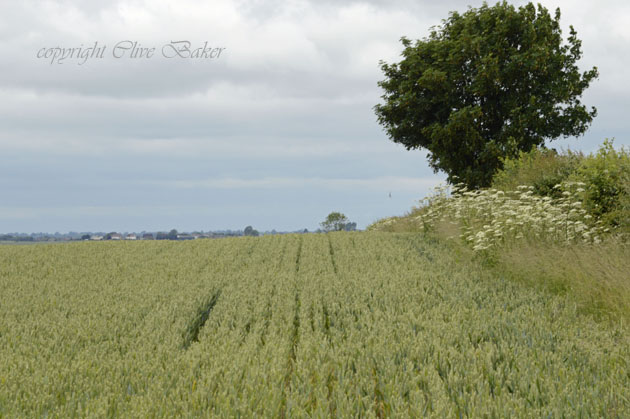
Summer crops in a Cambridgeshire field, could these now be the ingrediants of a local pint I shall be drinking tonight?

Summer crops in a Cambridgeshire field, could these now be the ingredients of a local pint I shall be drinking tonight?

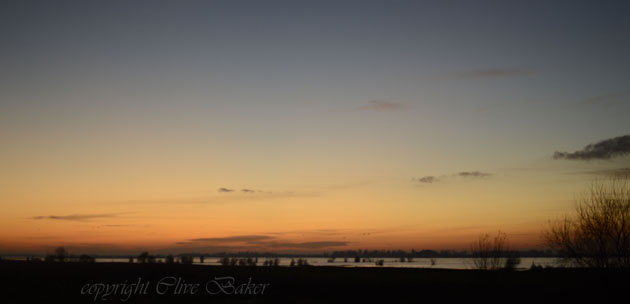
Sunset over the washes

Sunset over the washes Dec 2014

Large water filled drain edged by trees

One of the drains that surrounds Woodwalton fen

History in the Landscape

In this day of the internet and e-mails are we in danger of not recording events that have an impact on our landscape that may local to where we live, the world has been made smaller by the World Wide Web, but 100 years ago recording events local and national was by ink and paper, by newspapers or by people keeping diaries.

I mentioned in an earlier Blog Canon Reginald Augustus Bignold (1860-1944) Rector of my home village of Carlton Colville in Suffolk, from 1898 to 1944.

Canon Bignold made a diary that he had written in the fly leaves of the Parish Records and give an insight into the village and the effect the First World War had on it, the villagers and Canon Bignold himself, discovered in 1971 by the then rector of Carlton Colville the Rev. Frank L Thomas and later published as a book by J.R. Goffin, ‘The Carlton Colville Chronicles gives us an insight in to the life of the people of a small rural community on the Norfolk / Suffolk border, near to the coast their lives revolved round the sea, land and a war in a far off land.

Now when I return to the village of my birth it is hard to tell where the village ends and the start of the town of Lowestoft begins, I could still point out where the old black smiths once stood, the church and rectory still stand and where cows once grazed in the fields round the old Hall now stands modern houses and thanks to this book I can now see the village as it was 45 years before I was born there.

Cover of Book

The Carlton Colville Chronicles, copyright Parochial Church Council of St.Peter’s Carlton Colville

For example on this day 100 years ago Canon Bignold wrote:

January 19th 1915 ‘Bombs dropped from airship on Yarmouth, The house in the village were much shaken’ (Carlton Colville is 12.9 miles from Great Yarmouth)

He continues ‘Two hundred and thirty of our men have joined H. M. Forces. I have gazetted Temporary Chaplain of the 25th London Cyclists Battalion’

(copyright Parochial Church Council of St.Peter’s Carlton Colville)

So just from that small entry over 100 years ago we have a small window on the past, the horror of the first bombs dropped from the air on civilians, the numbers of men joining up and the vision of men going to war on bicycles

The are on the World Wide Web, sites that are recording the past and I am sure there are many on East Anglia, so as i now live Cambridgeshire in the West of the region here is a link to Ely, memories of Ely Pits and Meadows

So next time you are in the countryside and looking at a pond, it may just have been created by a bomb dropped from an airship over a hundred years ago, somewhere they may be a record of this.
Hare today

Yesterday I was leading the Hare walk  at WWT Welney as a volunteer I usually do the guide in the hide, swan feeds and the hare walks.

I like the hare walks because you get to see the hares running around, boxing or just keeping low and making an escape when you are nearly on top of them.

The stronghold of the Brown hare is East Anglia as they like arable fields and you are more likely to see them running around the fields here.

But yesterday I saw a sight I have never seen before as I was leading a group of sixteen people round somebody said ” is that a bird of prey over there? ” as I looked in the direction they were pointing I could see it was, in fact I could tell it was a harrier, but as we were facing into the sun and we had a sighting at Welney of a male Hen harrier earlier, I needed to try to see if it was a Marsh or Hen harrier, I set up my scope to watch the bird and as it got lower and out of the sun I could see it was a Marsh harrier, then I noticed on the ground a hare feeding and the harrier was getting lower and heading for the hare, I wondered what was going to happen next as a hare seemed to big for a harrier to take.

The harrier landed on the ground behind the hare and the hare turned round and faced the harrier, they were nose to beak and just sat here in a face off, I could not take a photograph as my lens was not good enough and they were quite away off.

I do not know if this was a fairly young harrier or if the hare was a female and wondered if she should fight off the advances of the harrier but they just sat there staring at each other, they could still be there now!.

Hares staring at each other

A pair of hares facing off

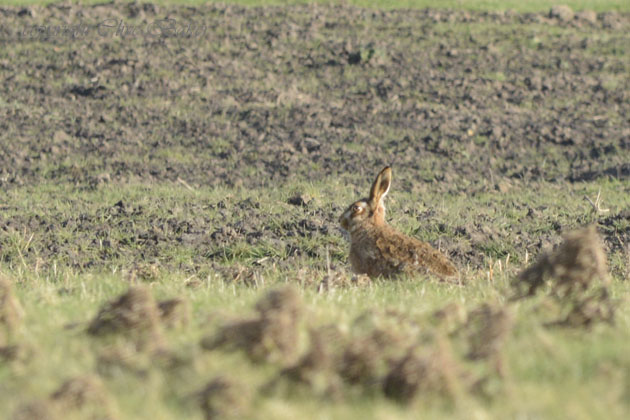
Lone Hare

Lone hare at home in the East Anglian Landscape

Winter Sun and Kingfishers

On our Lunchtime walk two colleagues and myself sometimes get a glance of a kingfisher along a small stream not far from our place of work, most people have never seen a kingfisher so you may consider us lucky, so you may even be envious when I tell you on Wednesday we saw three, add to that we saw one on a branch, we stood and watched it from only about 2 metres away, it was looking at us but did not move, we soon discovered why as it was watching a fish, it suddenly flew towards us and plunged into the water only about a half a metre from our feet, and this was the day I did not have my camera with me.

What is amazing about this is the stream is in the city of Cambridge by the botanical gardens but also near a busy road and footpath and there are a lot of people walking past oblivious of these small but brightly coloured birds.

Yesterday we did not see one, but I put this down to being windy and the water had a lot of ripples on maybe making it hard to see any fish. So today I took my camera to work and the wind had dropped and it was sunny.

Kingfisker sitting on branch

Usually the kingfisher can be overlooked as it sits quite still

I can see how some people miss them, if you are not looking for them and they sit quite still then unless they fly and you see that electric blue catch the sun, then you may miss it.

Kingfisher amongst leaves

Some can be sitting in amongst the evergreen shrubs, but if you look carefully

But some may be easier to see

Kingfisher on branch in the Sun

Kingfisher sitting in the winter sunshine

The easiest way to identify the sex of the kingfisher is by the bill, the female has  red on the base of the bill ( think of a female wearing lipstick )

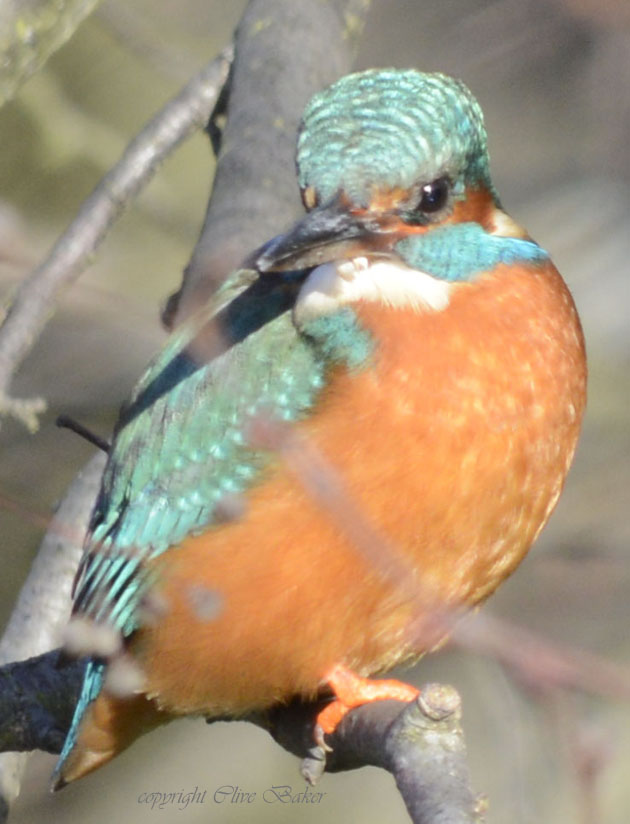
Female kingfisher

Close up of Kingfisher, this is a female as it has red on the base of the bill

The male has bill that is all black.

All in all we were lucky again, so if you are walking along a stream or canal look carefully in the undergrowth by the water as you may miss this jewel of the bird world.

Kingfisher hidden in shrub

Kingfisher hiding in the undergrowth


The feeling of being watched

Sometimes you do not need to go far to see wildlife, in fact just a glance out of the window can provide results, it is always good to have things in the garden that will attract wildlife like feeders, nest boxes, a small pond and the right plants and shrubs for food and cover.

One bonus in the Winter is having shrubs that produce berries, like the Cotoneaster we have under out front window, which provides lots of bright red berries that the birds love, some mornings when it is cold I have seen, sparrows, blue tits and blackbirds feeding on he berries, in really cold weather I have come home to see redwing and fieldfare fly away from the shrub.

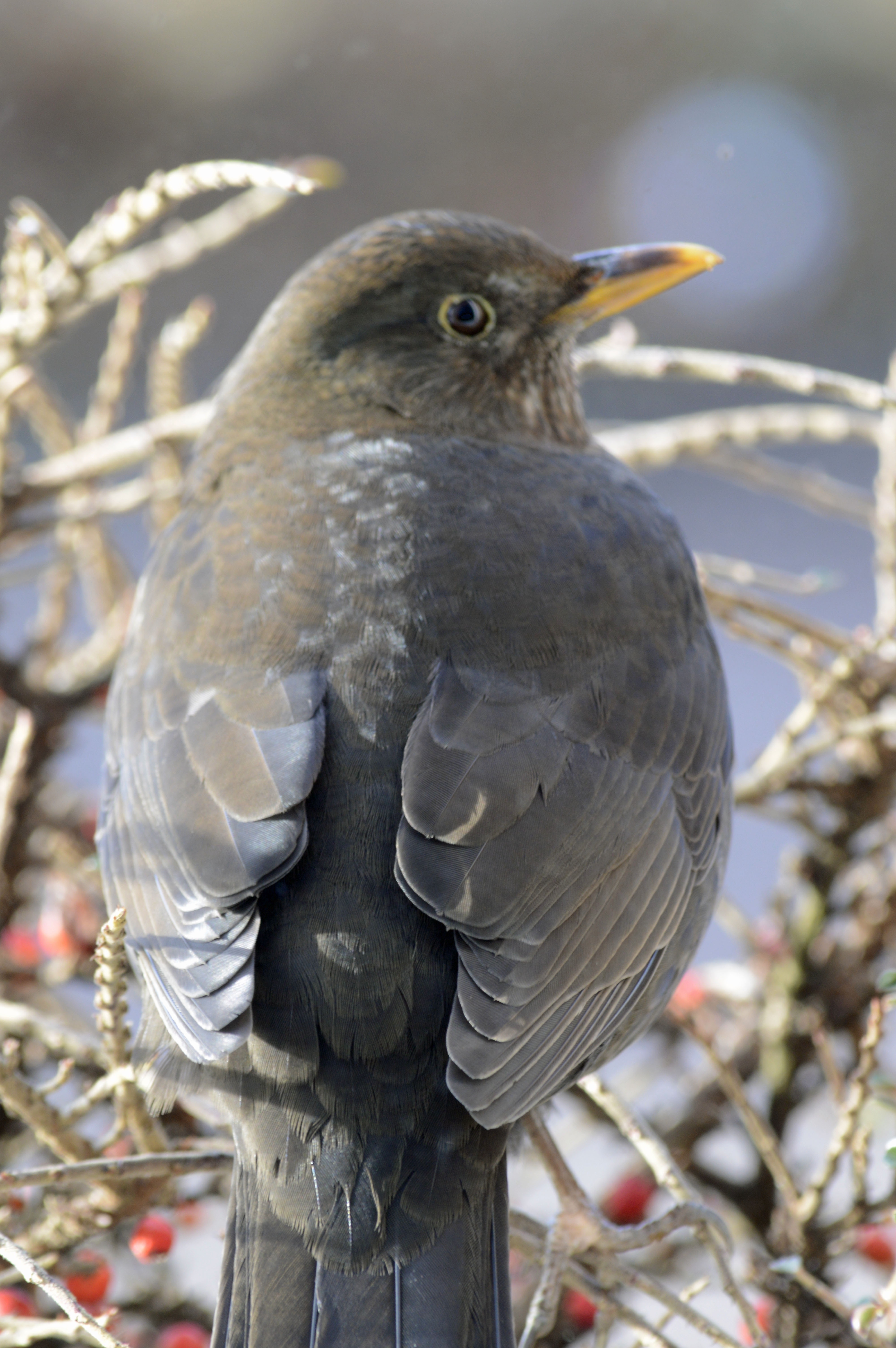
But it is the blackbirds that seem to be the more bold I have often sat with my back to the window with the feeling I am being watched, like this Sunday when I sat reading the Sunday paper, I turned round and saw a female blackbird eating the berries, it looked at me and I looked back at her,we were eye to eye only inches apart with only the double glazed window between us.

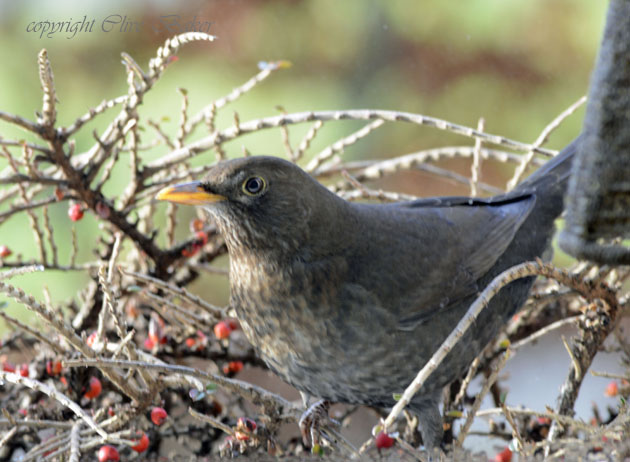
Female blackbird feeding on berries

As she ate the berries, the female blackbird gave me the eye.

She stayed there long enough to let me get up and fetch my camera, but as I took a couple of photographs she decided to turn her back on me as much to say, if I can not see him he can not see me.

Female blackbird

The blackbird decided to turn her back on me in disgust

It is only when you see these birds close up you can see wonderful nature is.

Early signs

There have been reports in the papers recently about wild plants being in flower early, the Botanical Society of Britain and Ireland held a four-day survey starting on New Year’s day and the result showed 368 species in bloom compared to 222 species last year, the figure for this time of year should be 30.

I can believe this as I have noticed a cowslip with flower buds opening in my garden this week, I also I saw my first snowdrop in flower on 28th of December.

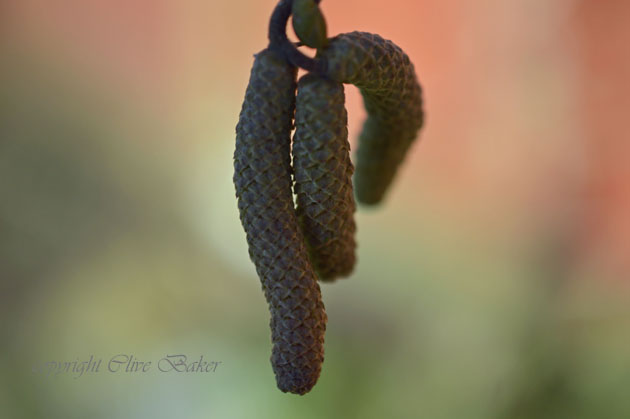
Yesterday I noticed lots of catkins out mostly hazel which is not unusual for this time of year as catkins are always the first to show, catkin bearing plants take advantage of the winds to pollinate and do this before other plants start to flower.

Three hazel catkins

Hazel catkin the ‘Male’ part of the plant

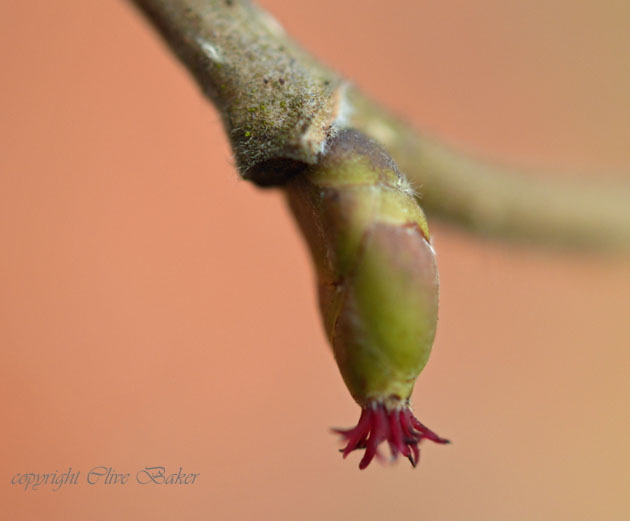
What I have noticed this year on the hazel plants is that there are a lot of the flowers, the female part of the plant, they are very small and you need to get really close to see them, these are the parts of the plants that catch the pollen from the catkins.

Very small red flower

Hazel flower the ‘Female’ part of the plant.

The other thing I have noticed is some of the hazel have green leaves on, which is very unusual for this time of year, I am not sure if they have opened recently or have managed to hang on over winter.

But next time you are out and about and you see lots of catkins, look carefully for little red flowers on the end of buds and you will be looking at hazel flowers.

Hibernating somewhere near you

On this cold dull January day, it may seem funny to talk about butterflies, but somewhere near you may be a hibernating butterfly, maybe in your shed or your garage in some dark corner.

Four species usually overwinter in Great Britain the brimstone, usually the first butterfly seen on a warm Spring day and it’s colour may have given us the name ‘butterfly’ as it is a yellow butterfly, the other three are comma, peacock and small tortoiseshell, but over the last few years they have been joined by a fifth butterfly the red admiral which would usually have migrated South to warmer parts of Europe, this is due to the mild Winters we have been having.

On warm days we may sometimes see butterflies flying in January and February, I once saw a peacock butterfly on December 26th on a very mild and sunny day.

Very colourful butterfly feeding on flowers

Peacock butterfly

Unfortunately some of these butterflies that we may see in the early months of the year January, February and March may not survive mainly because any cold snaps will kill off any early blossom and flowers so cutting off their food source.

red admiral butterfly on flowers

Red admiral butterfly

Most of the red admiral butterflies that have overwintered in the last few years do not survive but those that do have their numbers boosted by red admirals that migrate from central Europe in the Spring, but as we seem to be going through a spell of cold then mild days I bet it will not be long before we see a butterfly flying if not outside but at your garage or shed window.