Wassailing Time

Being twelfth Night (January the 5th) it is traditionally a time for Wassailing, also the night your Christmas decorations should be down as it is unlucky to still have them up after tonight.

Wassailing is thought to date back to Anglo-Saxon times maybe from an Anglo-Saxon toast Wæs þu hæl, meaning “be thou hale” or if you like maybe ‘Good Health’, wassail was actually a drink made of mulled ale, curdled cream, roasted apples, eggs, cloves, ginger, nutmeg and sugar.

There were two forms of Wassailing the house visiting and Orchard visiting, the latter seems to be more popular in the West Country, mainly Somerset, Devon,  Dorset, Gloucestershire and Herefordshire all the main cider producing counties, but of course East Anglia once had many orchards, most lost after the second World War due to more land being wanted for the growing of other crops.

The Orchard wassailing is where Slices of bread or toast were laid at the roots and sometimes tied to branches. Cider was also poured over the tree roots. The ceremony is said to “bless” the trees to produce a good crop in the forthcoming season.

I dare say there are many variations on this custom but I think the meaning and outcome is the same to bless the household and orchard with good health and wealth in the year ahead.

Good Health one and all.

A large crop of red apples

A good start to the year can produce good results later on
Testing the camera

Today I was back at WWT Welney, my first swan talk and feed of the year, despite the fog and frost there were a good number of people there, and there were quite a few birds to see, including a green-winged teal.

For this time of the year the water levels are low, last year we were having to wear dry-suits and use the floating wheelbarrow to do the feeds, but today nearly all the hides were open to the visitors, having said that it was very cold, so cold I decided to do all of the talk inside and not do any of the talk outside as I feed the swans.

But this gave me the chance to try out a camera on the wheelbarrow to try to capture the talk, so here is the result, there is a few seconds of darkness as I am in the tunnel to open the gate.

Bullfinch and Kingfishers

Today we had our local wildlife group new year walk around Ely, the forecast looked grim but it had stopped raining by the time we started our walk at 10:30 am, by the time we got down to the river we heard the call of a Grey wagtail as we looked for it a Kingfisher so at the same time we had two birds to look at Grey wagtail on the rail bridge and a Kingfisher on a branch by the bridge.

The sky looked dark but as we walked along the river we had a snipe fly over and land amongst the vegetation on the flooded meadow to our left soon to be hidden from view.

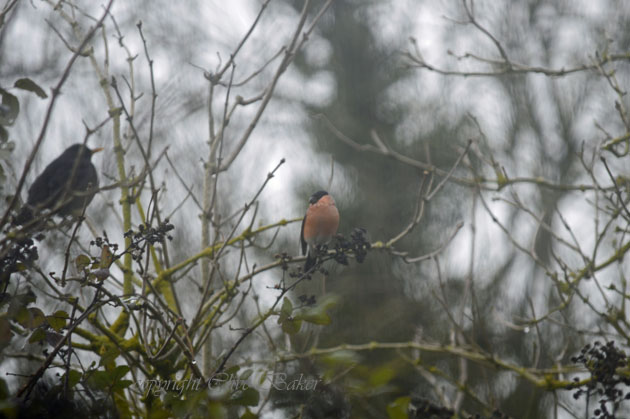
But the best spot of the walk was as the weather turned for the worse and the rain started to come down again we had a small group of four Bullfinch all appeared to be males but there may have been one female as most of the group showed us their white rumps as they flew in front of us, but at least two of the males allowed us to get close and see them in all their glory.

Bright red breasted male Bullfinch

A male Bullfinch allows us to get a close look at him

These are quite a handsome looking bird and in the Winter they tend to fly in groups, perhaps as more birds can look for food or maybe as there is little leaf cover at this time of year more eyes are better to look out for the odd Sparrow hawk on the hunt.

Same bird but closer

Closer look at the Male Bullfinch

It was raining quite heavy when I took these photographs of the Bullfinch so I was quite pleased they have come out well.

So a good start to the New Year with another 3 hour walk and 6 more birds added to the list.

New Years day walk

It has become a bit of a tradition for me now to always go for a long walk on New Years day, two reasons really to start my bird list off for the year and to blow away the cobwebs of the old year (and a few pounds gained over Christmas).

The last few years I have taken a circular route of about 7 miles, I start by walking down to the river Great Ouse from my house and then along the bank to Little Thetford, this is where I saw a buzzard going along the trees, a bird that would have been quite rare here a few years ago but now is quite common in East Anglia, as I approached Little Thetford a Kingfisher flew past me, as I was now nowhere near the river I guessed it had been looking for small fish along the ditches.

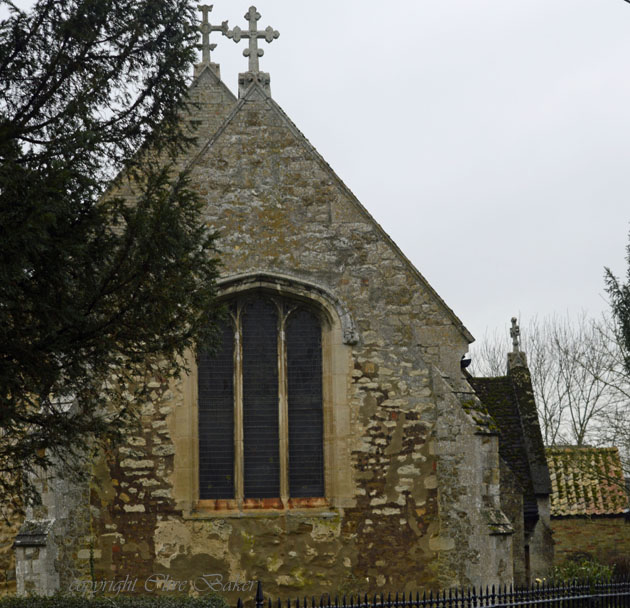
Little Thetford is a nice village with a mixture of new and old houses, some of the old houses are thatched, but I think the surprise here is the church, unlike Ely cathedral that can be seen for almost all of this walk St Georges church in Little Thetford is not seen until you almost on top of it, it was once thatched like some of the older houses but was given a slate roof in the mid 1800’s and not long after was struck by lightning and had to be almost rebuilt, it has no tower or steeple and was once known as a ‘Chapel of Ease’

Image of church, window.

St. Georges Church, Little Thetford.

Walking past the Church and then the thatched ‘Old Post office’, I left Little Thetford via a path between houses and the recreation ground to cross fields where my boots seemed to double in size by the amount of mud now clinging to them.

Church Door

Church door of St Georges Little Thetford.

Soon I am walking between hedgerows and over the field I can see the Buzzard again sitting on a branch in a group of trees, a magpie sat nearby dwarfed by the size of the Buzzard.

I returned home via the golf course, where quite a few golfers were playing but they seemed to be outnumbered by the black-headed gulls on the greens which I guessed were looking for worms now the frost of the last few days had gone.

It usually takes me around 2 hours 45 minutes to walk this route but today took my 3 hours 20 minutes maybe because I was looking at the birds and wildlife along the way, and if you were wondering I saw 39 species of bird to kick my year list off.