Birds behaving badly and Strangely

Yesterday morning I was walking the dog when I heard the sound of a blackbird it was the alarm call but seemed quite slow and low in looking closer into the hedge I could see it was two males and the one making the sound was stuck by its wing in the branches of the hedge.

Two male blackbirds

Two black birds in hedge

At first I was thinking that one bird was trying to release the other but could see the upper blackbird was attacking the one stuck and was trying to peck at its eyes.
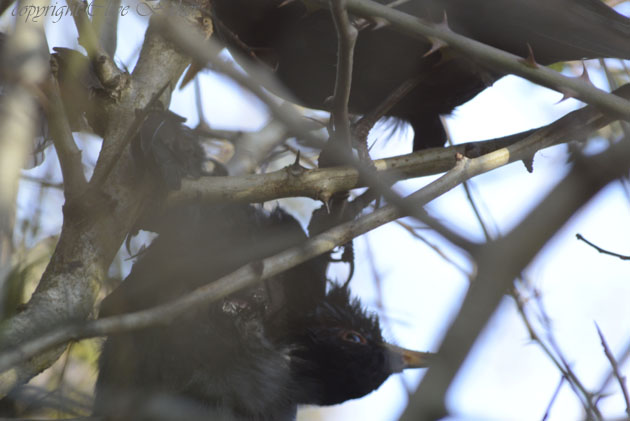
Male blackbirds fighting in hedge

The upper blackbird was getting the upper hand

This was obviously Male blackbirds fighting to establish a territory or one of the males defending its territory, as we are getting near the nesting season I was guessing this was more to do with breeding than over food, the upper bird flew off when it saw me and the bird stuck in the branch was looking exhausted.

Lone blackbird stuck by wing in hedge

The Stuck bird was exhausted.

The bird hung there by its wing and after a while it started to breathe heavily, once or twice it tried to free its self and soon became weaker, I am afraid I could not leave it there but it was hard to reach but with the aid of a stick I managed to move the bird upwards and it flapped about as I tried to free it, I did succeed and it half flew and half fell into the garden beyond, I do not know if it survived but I gave it half a chance.

Nature can be cruel at times and birds will fight to death over territory, but sometimes they can be amusing like the blue tit that insists in coming in to our garden and for the last two years has been attacking or courting I am still not quite sure its own reflection in a window, I have managed to get this on film and excuse me at the beginning but wait 40 seconds for the blue tit to appear and you will see what I mean.
The Fens made in Scotland

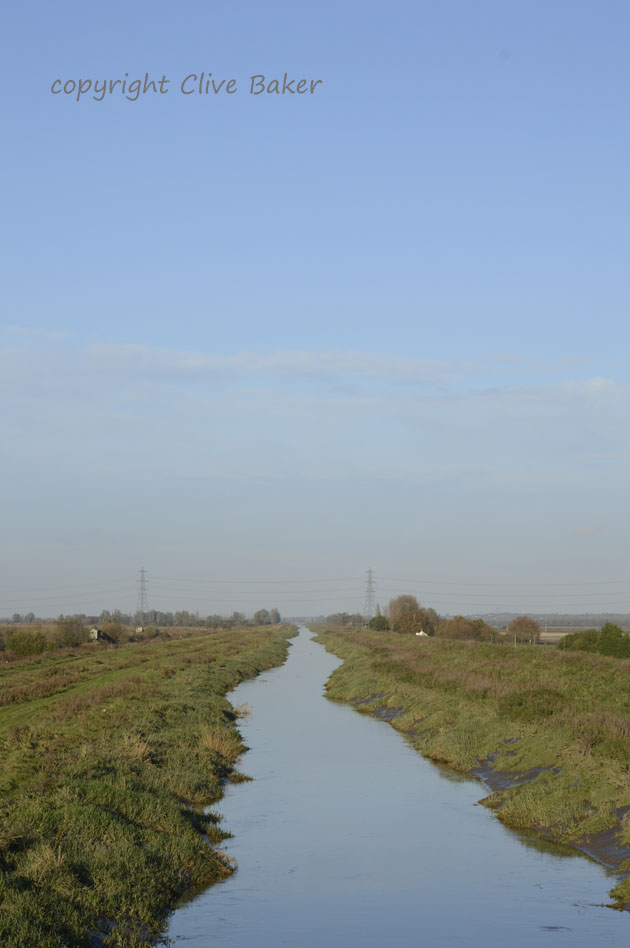
Looking from bridge over river

Looking North over the Bedford New Cut, Welney

Looking over the fens of Cambridgeshire and Norfolk today it is hard to imagine that the landscape was created by the hands of men with the basic tools of a wooden spade and a woven basket to move the earth.

The draining of the fens began around 1631 when the first drains were cut to channel the water from the vast wetlands, this was a landscape where people used boats to move between villages as there were few or no roads, the people who lived here did not want their way of living changed so the early group of gentlemen adventurers who were financing the drainage found it hard to get local labour to carry out the scheme.

I suppose you could say their salvation came from the English civil war in the form of forced labour using prisoners, like around 500 dutch sailors taken from a sea battle off Portland Bill, but the majority of the prisoners they used were Scottish soldiers who fought against the parliamentary ‘Roundheads’.

Many of these prisoners were held in gaols and were forced marched from places like York to the fens to start the digging of drains and straightening and deepening of existing rivers to increase the water flow and digging of new large new drains like the Bedford New cut 21 miles long.

They were made to wear white course wool suits to make them stand out as prisoners, they lived in wooden huts that were dismantled and moved along as they dug out the drains.

Life was hard as they dug and carried their baskets of mud to create the banks, many died of exhaustion, bronchial or malaria related diseases in the harsh landscape of the fens, as it was costly to move any bodies to graveyards the bodies were buried in the banks of the drains.

The Scots were preferred to be used  for this work as they were hardy and came from a land where the conditions were like those of the fens even if the landscape was very different, many managed to escape and were helped by local fen folk who were opposed to the draining, an escaped prisoner was not pursued if they managed to get as far north as the River Trent.

After the end of hostilities many were released and returned to their native Scotland, but others stayed and married local women.

As you look today at the banks they created you will notice the flat tops, by doing this they had made walkways to make getting around the fens easier, they also made roads on the reclaimed land so really we have a lot to thank these men for as we travel with ease around the fens, perhaps we may pass by the forgotten body of one of the thousands of Scots who died creating this landscape one that we could say was ‘Made in Scotland’

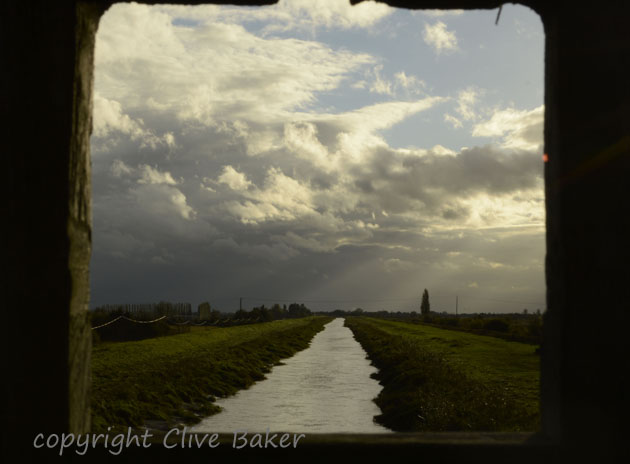
Bedford new river from bridge

Bedford new cut from footbridge at WWT Welney

Collective Nouns for the countryside

This Friday we have one of our Local Wildlife group talks in Ely, Unfortunately the person how was going to do our talk has been taken ill, so Helen one of our committee members has jumped in at very short notice to do a talk on “Poisonous plants – a question of degree!”

Man has known of and made use of poisonous plants for both good and evil for thousands of years. Amongst those assassinated using plants were Socrates in 402BC and much more recently George Markov. Others have died accidentally, yet many have been grateful for the medicinal effects of poisonous plants. The talk will include a few surprises and possibly some unexpected serious warnings.

So I am looking forward to hearing Helen’s talk, but as Helen’s husband Terry had hosted our January talk this started to get me thinking perhaps I should have a talk just in case we are in this situation again in case the speaker booked for the evening is taking ill and we need to step in.

I have not actually done a talk on a subject only lead the hare walks and done swan feed and talk at WWT Welney, so maybe base one on the ‘Hares’ so I started looking in my books and more information on hares and started looking at facts and found the collective nouns for hares and was surprised, for example a group of hares can be  a Drove (very apt for the fens), husk, trace or trip, two = a brace and three a leash.

Then I started looking at others and could not stop, so here goes:

Ferrets – Business

Moles –  Labour ( only really get together for mating, usually solitary)

Rabbits – Nest

Coots – Covert

Curlews – Herd

Ducks – Team (in flight) or Paddling (on water)

Herons – Siege or Rookery

Jays – Band

Lapwings – Deceit

Mallard – Flush

Nightingales – Watch

Partridges – Covey

Plovers – Congregation, flight, wing or stand

Pochards – Rush or flight

Rooks – Building or clamour

Snipe – walk or wisp

Sparrows – Host or tribe

Swans – Herd or team

Teal – Spring, coil or bunch

Wigeon – Company

and Woodcock – Fall or flight

These are just a  few and all can be found in East Anglia, so next time you are out and about and see a collection of the above, impress your friends and family with your collective nouns of the countryside.

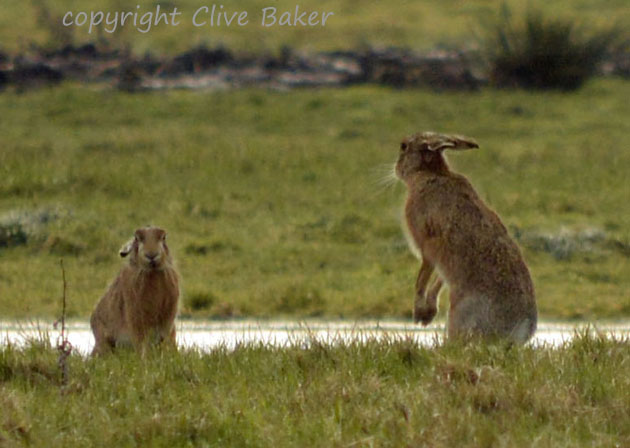
Two hares facing each other

a brace of hare

Tragic drowning of Sea Scouts

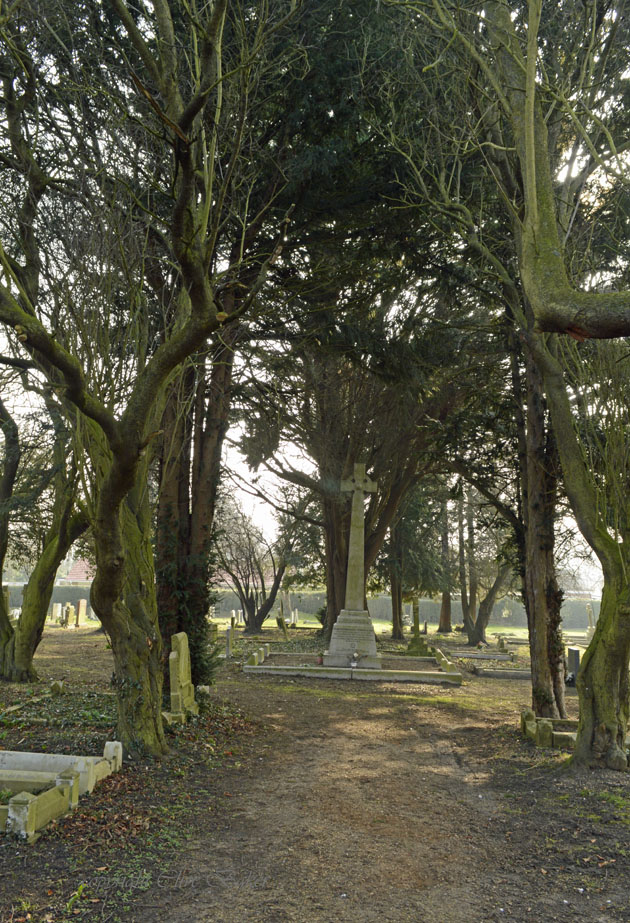
Today I returned to my home village of Carlton Colville near Lowestoft in Suffolk, I have wanted to write about this incident that happened over 100 years ago, I had seen the graves in the local churchyard that even then was known as the ‘New Churchyard’ it is not next to the church not a few yards up the road just up from what was the old school-house, in the centre surrounded by now tall yew trees is a large grave with a towering stone cross.

Large stone cross under trees

New Churchyard Carlton Colville

You are drawn to the large cross as you enter the Churchyard, and it was here I first saw the names and the ages beneath at the time I was younger and they seemed so much older and mature to me then but when I visited today they are all so young.

On Whit Monday June 1st 1914 Six members of the 1st Carlton (St Marks) Troop of Sea Scouts drowned on the River Waveney beneath Somerleyton bridge after their boat capsized, I have found quite a detailed account here Broadland Memories that goes in to more detail of the event.

Unknown to me then I was later to find there was a family connection as my Great Uncle Billy Hall was the son of a boat builder in Norfolk. Uncle Bill’s Father and Grandfather had their Boatyard in Reedham Norfolk and the main trade for ‘Halls’ boatyard was to build the Norfolk Wherry, a trading barge used on the Norfolk Broads, he told me he remembered his Father and Grandfather having to make the coffins for the scouts and their leaders, he believed the bodies may have been brought to the yard, at the time he may have been around the same age so this would have had an impact on him.

The Scouts and their leaders were buried on June the 5th 1914, the Bishop of Norwich conducted the funeral and thousands of people including 300 scouts lined the route from Oulton Broad to Carlton Colville and there were forty’ mourning coaches’

Main Inscription

The Main Inscription on the base of the cross

The victims were:

T W P Lory the Scout Leader

T W P Lory the Scout Leader

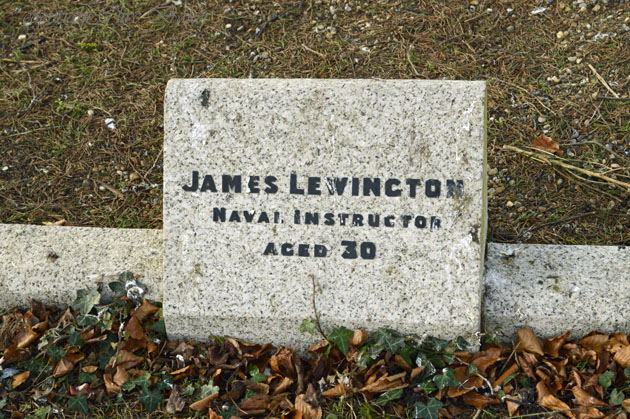
James Lewington Naval Instructor

James Lewington Naval Instructor

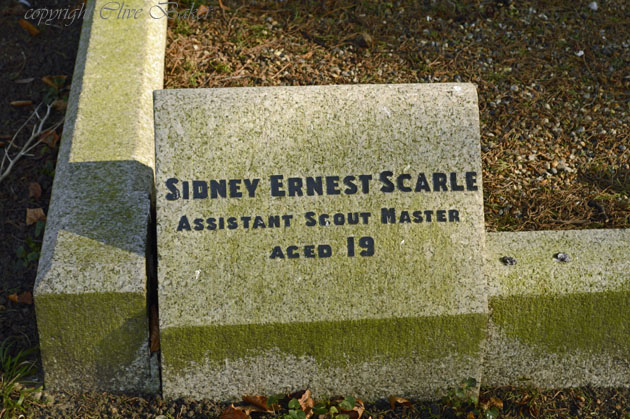
Sidney Scarle Assistant Scout Master

Sidney Scarle Assistant Scout Master

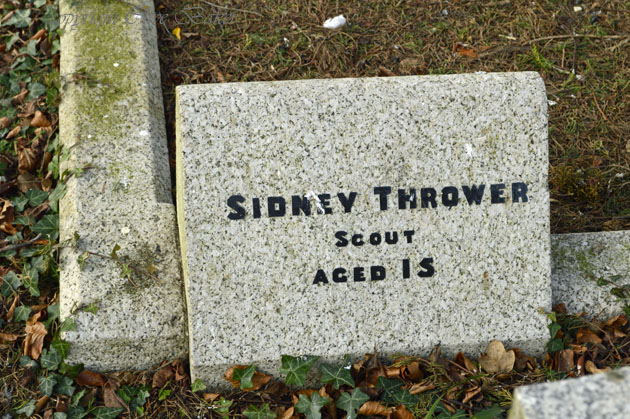
Scout Sidney Thrower

Scout Sidney Thrower

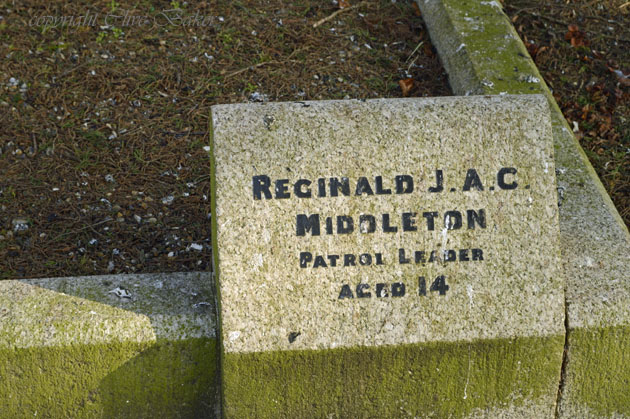
Scout Reginald Middleton

Scout Reginald Middleton

Scout Arthur Beare

Scout Arthur Beare

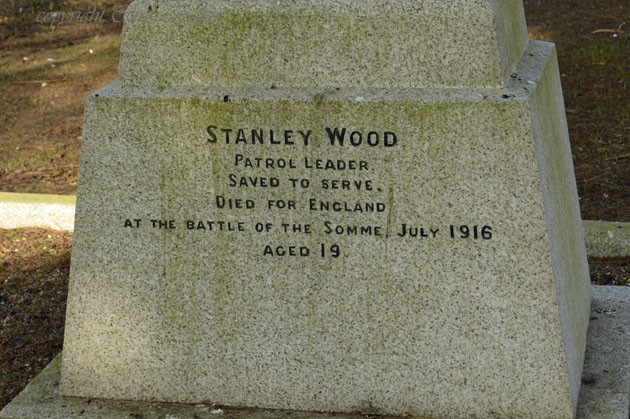
And maybe there is one more sad footnote to this Tragic event, there was one scout Stanley Wood who was saved in the disaster, he must have been racked with guilt that he had survived as in the book ‘Carlton Colville Chronicles’ Canon Bignold describes Stanley Woods ‘as a bright, clever boy, respected and popular with everybody’, Canon Bignold had told Stanley that God had reserved him for greater things, Stanley was killed in the Battle of the Somme in July 1916, aged 19.

Stanley Wood survived the disaster to die in the Somme

Stanley Wood survived the disaster to die in the Somme

A sad story that seems so sad even now.

Wicken Fen

Today I had a day off work an appointment in the morning but the afternoon was free, so I decided to have a walk around Wicken Fen, it was a dull day and the light was really low, but it is always a joy walking round what is the oldest nature reserve.

As I left the car park and walked down the track past the centre I could see lots of birds on the feeders, including a male and female mealy (common) redpoll the male already showing its breeding colours having a red tinged breast, slightly larger than the lesser redpoll which you are more likely to see in the Summer, I was lucky to see these two birds as there are usually only about 310 birds in the winter and only 3-4 breeding pairs in the Summer.

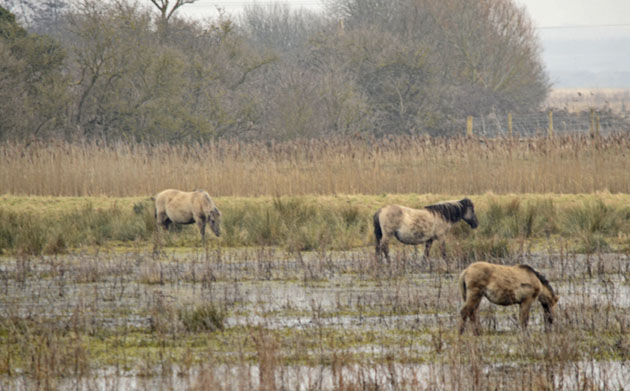
As I walked round the fen I was soon away from any walkers and regretted not wearing any gloves as it can get cold out here, I could see the Konik ponies on the fen, used here as they tend to feed on young trees and scrub and in doing so they are keeping the fen as it should be.

Threes ponies feeding in very wet conditions

Konik ponies grazing on the fen at Wicken

I stood and watched for a while and took in how quiet it was, no sound of Traffic only the wigeon whistling on the fen.

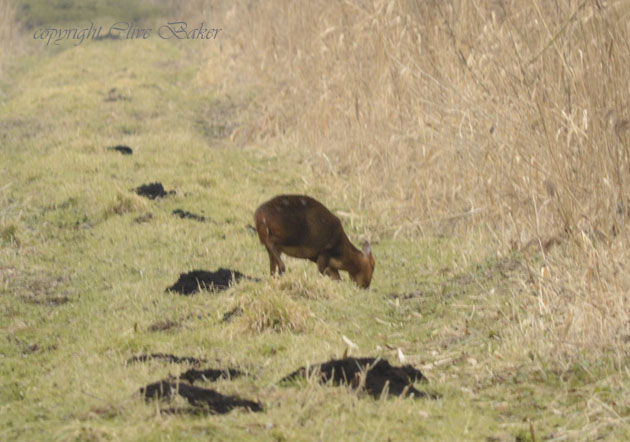
As I turned up the track I could see in the distance a Muntjac deer grazing on the track, there were more Konik ponies grazing in another field I stood here a while when suddenly a barn owl seemed to fly from nowhere, un seen by me it had been sitting on a low branch at the side of the field as when it had finished it’s hunting it returned there.

Barn Owl flying low over a field

the sudden appearance of a hunting Barn Owl

I watched the Barn Owl hunting for a while and decided to carry on up the track, The Muntjac was unaware of me and carried on grazing I managed to get close.

Small deer feeding on track

Munjac was unaware of me as I walked along the track

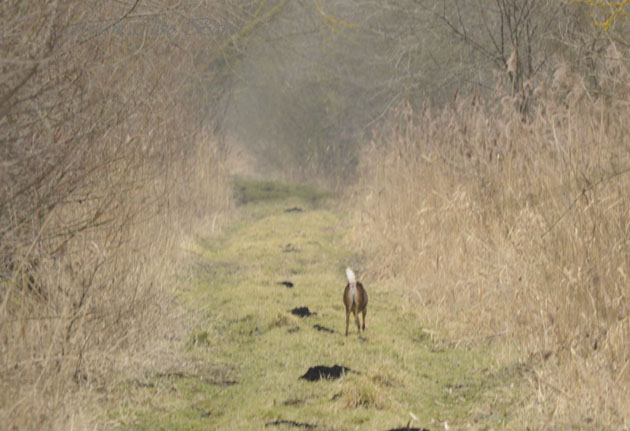
I wondered how close I could get, but all of a sudden it heard me and sprinted off up the track tail up and soon disappeared into the reedbeds.

Deer running tail up in the air

The Muntjac takes flight

I was now turning back towards the main centre as I walked along Wicken Lode, but I could just make out something in the red beds in the distance and using my scope I could see a male Marsh Harrier sitting on a post turning its head looking from side to side the eyes not missing a thing, I watched him for a while until he flexed his wings once or twice then he took to the air flying over the reeds and away.

All in all for such a cold grey day there was lots to see, even if my hands were cold.


Sounds and Signs of Spring

We could almost be lulled into a false sense that Spring is just around the corner, the Sun has been out and the temperature  is double to what it was this time last week, add to that the birds are singing louder and I heard the sound of a woodpecker drumming on a tree today all the signs seem to be there, in a secluded spot where I could see beehives the honey bees were swarming around the hives another sign surely?, snowdrops are in flower, aconite carpet the ground and there is even the odd daffodil in bloom all there for the bees to feed on, but we all know at this time of the year the weather can turn on its head in a moment, in shaded areas there are small patches of snow, and old saying “If the snow lays there it is waiting for more” could be true.

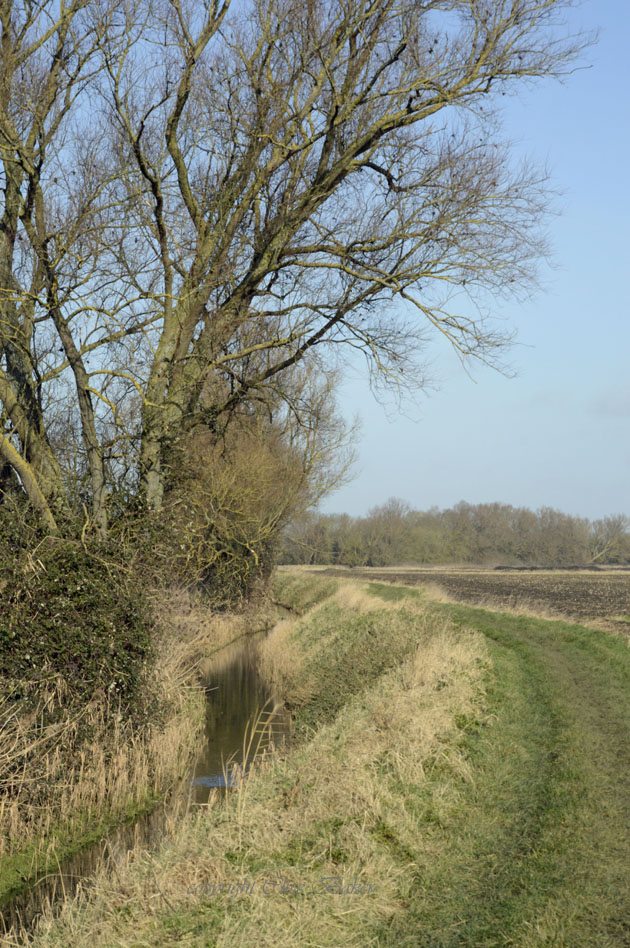
Country track by a stream

Walking the East Anglian footpaths.

But when the sun shines and the skies are blue, the birds sing and the spring flowers appear, I will keep thinking Spring is just around the corner.

After the cold

After a week of ice, snow and sleet there were signs that we may be heading to a warm spell, the wind still has an edge but there seemed to be a lot of activity in the natural world.

Squirrels were digging up their hoards of  nuts buried in the Autumn and now easier to dig up as the frozen ground begins to thaw.

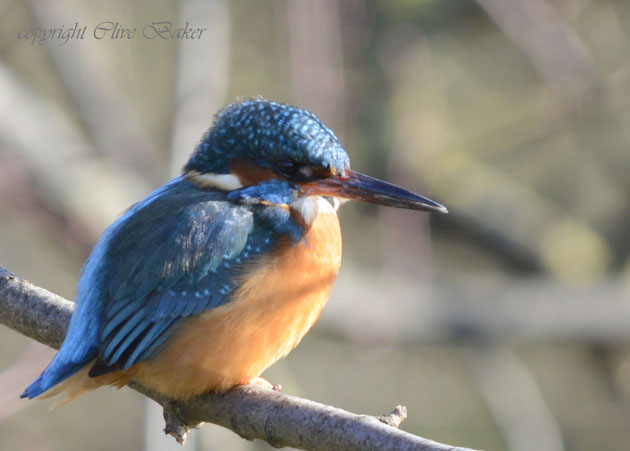
Kingfisher on branch

Kingfisher waits in the Winter Sunshine for a fish to pass by in the water below.

The Kingfisher has returned to the now unfrozen stream to catch fish that had been protected by the ice that had covered the water below.

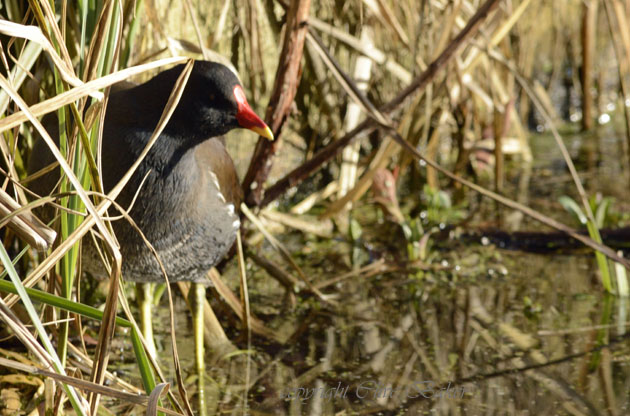
Moorhen on the edge of reeds

Moorhen in the reeds

The moorhens now patrol the reedbeds, their yellow and red bill brightens up the gloom of the reeds at it catches the sun.

Bird bathing

Song thrush washes itself in the stream

And birds like the Song thrush takes advantage of the water to have a bath in the stream.

If anything it proves how much the wildlife depends on water as we do for life and as the sun shines dare we start to think of Spring?


Hares and inspiration

It has been a cold end to the week so I made sure the bird feeders were filled up and the water was changed and bird baths cleaned to give the birds a chance of survival.

Yesterday I was a WWT Welney  doing the hare walk and then the afternoon swan talk and feed.

For the last three weeks the hare walks have been full sith people having to be turned away, so I had another 16 hardy souls willing to brave the snow showers as we headed out on to Lady fen “will we see any hares?” I was asked, Oh yes I said, I was then looking at 16 expressions that seemed to say ‘Oh yes’.

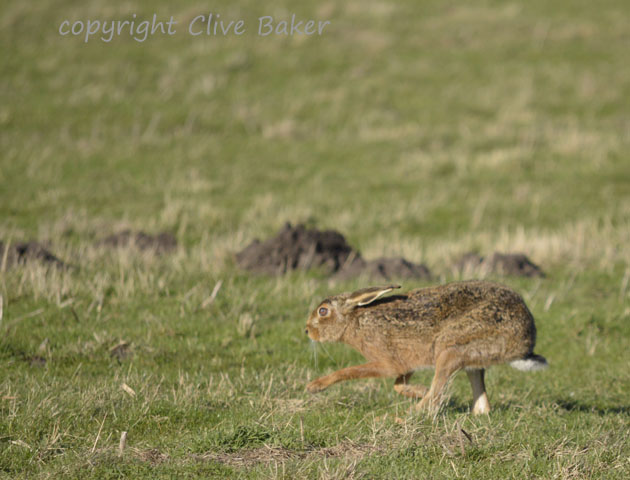
We headed out with the wind behind us and as we walked further out into the fen the shelter we had from the bank of the Bedford new cut so left us  I looked out over the field and sure enough I saw a ‘mound’ setting up my scope I soon focused it on the mound and with a relieved sound in my voice I said, “If you would all like to take a turn to look there is your first hare”, sure enough there was our first Brown hare hungered down against the wind and snow, ears back trying to keep as low as possible.

Hare about to run away

A disturbed hare taking flight

We soon had to retreat back to the centre as the wind a now sleet started to get really bad, I said we would give it 10 minutes and head out again, which we did, the rain, sleet and snow stopped but the wind was still strong and if anything dries us out from the previous outing, soon the group were rewarded with 7 hare sightings and we all headed back to the warmth of the centre, I was thanked and I headed over to main observatory for my guide in the hide stint before the swan talk and feed, I am always amazed by how far people travel to East Anglia for our wildlife, like the gentleman who had come down for the weekend from Glasgow fo birdwatching, he made the trip to Welney for the Bewick swans.

I did my talk and swan feed at 3:30 then said it there are any questions to come and see me I had a lot of than you’s and a few questions and then as I gentleman walked out he patted me on the shoulder and said ” You were inspiring “.

So now if any asks me why do you volunteer, the answer is above, for promoting our region, our wildlife and the rare time I get comments like the last one.

I shall be back next Saturday for my ‘stint’, my voice may go but my heart will be in as always.

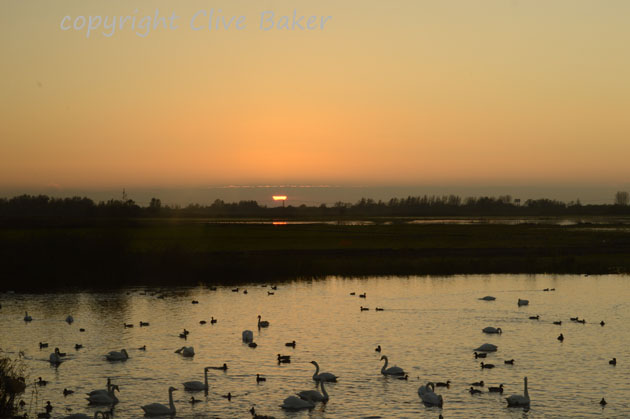
Setting Sun over the Ouse Washes

The Sun sets over the Ouse Washes, WWT Welney