This Friday we have one of our Local Wildlife group talks in Ely, Unfortunately the person how was going to do our talk has been taken ill, so Helen one of our committee members has jumped in at very short notice to do a talk on “Poisonous plants – a question of degree!”
Man has known of and made use of poisonous plants for both good and evil for thousands of years. Amongst those assassinated using plants were Socrates in 402BC and much more recently George Markov. Others have died accidentally, yet many have been grateful for the medicinal effects of poisonous plants. The talk will include a few surprises and possibly some unexpected serious warnings.
So I am looking forward to hearing Helen’s talk, but as Helen’s husband Terry had hosted our January talk this started to get me thinking perhaps I should have a talk just in case we are in this situation again in case the speaker booked for the evening is taking ill and we need to step in.
I have not actually done a talk on a subject only lead the hare walks and done swan feed and talk at WWT Welney, so maybe base one on the ‘Hares’ so I started looking in my books and more information on hares and started looking at facts and found the collective nouns for hares and was surprised, for example a group of hares can be a Drove (very apt for the fens), husk, trace or trip, two = a brace and three a leash.
Then I started looking at others and could not stop, so here goes:
Ferrets – Business
Moles – Labour ( only really get together for mating, usually solitary)
Rabbits – Nest
Coots – Covert
Curlews – Herd
Ducks – Team (in flight) or Paddling (on water)
Herons – Siege or Rookery
Jays – Band
Lapwings – Deceit
Mallard – Flush
Nightingales – Watch
Partridges – Covey
Plovers – Congregation, flight, wing or stand
Pochards – Rush or flight
Rooks – Building or clamour
Snipe – walk or wisp
Sparrows – Host or tribe
Swans – Herd or team
Teal – Spring, coil or bunch
Wigeon – Company
and Woodcock – Fall or flight
These are just a few and all can be found in East Anglia, so next time you are out and about and see a collection of the above, impress your friends and family with your collective nouns of the countryside.
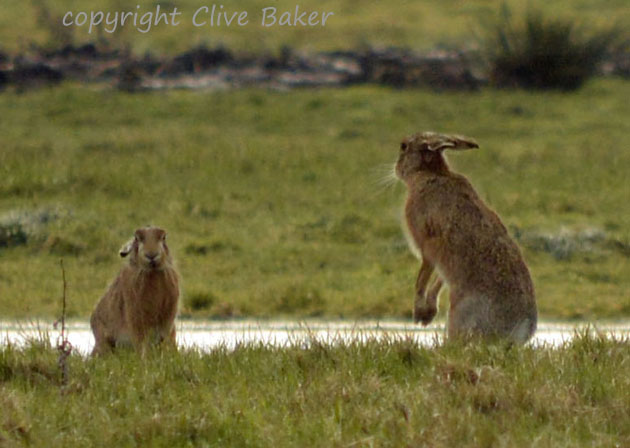
a brace of hare
 East Anglia the Wildlife, Landscape and People.