Wagtails

As I saw my first Yellow Wagtail of the year this week I thought it might be good to explain a little about them and the ones you are likely to see in East Anglia.

There are three Wagtails you are likely to see, then there are different races, I say three although some would argue the second race of the pied should be classed a separate Wagtail would make it four wagtails you are likely to see.

There are two vagrant Wagtails that occasionally turn up on our shores, the Eastern Yellow Wagtail a rare vagrant from Asia of which there have been around 11 confirmed sightings in the last 100 years, the latest being Winter 2019 in North Norfolk, this male was still there in January of this year.

And another vagrant from Asia the Citrine wagtail, less than 350 records of this wagtail, mainly seen September to October most of which are on the coast or marshy areas so good chance if you are going to see one is in East Anglia.

But enough of the rare birds and lets look at the ones you are likely to see.

First the Pied Wagtail (Mortacilla alba) and the race yarrellii, is the one most common to Britain, black rump, long black and white tail, black legs, white face, in the Summer a black bib and Winter a black chest band, the male has a Black back and the female dark grey you will have seen this bird walking with a fast run and constantly bobbing it’s tail, can bee seen in large numbers in winter forming evening roosts on buildings like Supermarkets where I guess they are getting the heat from the buildings.
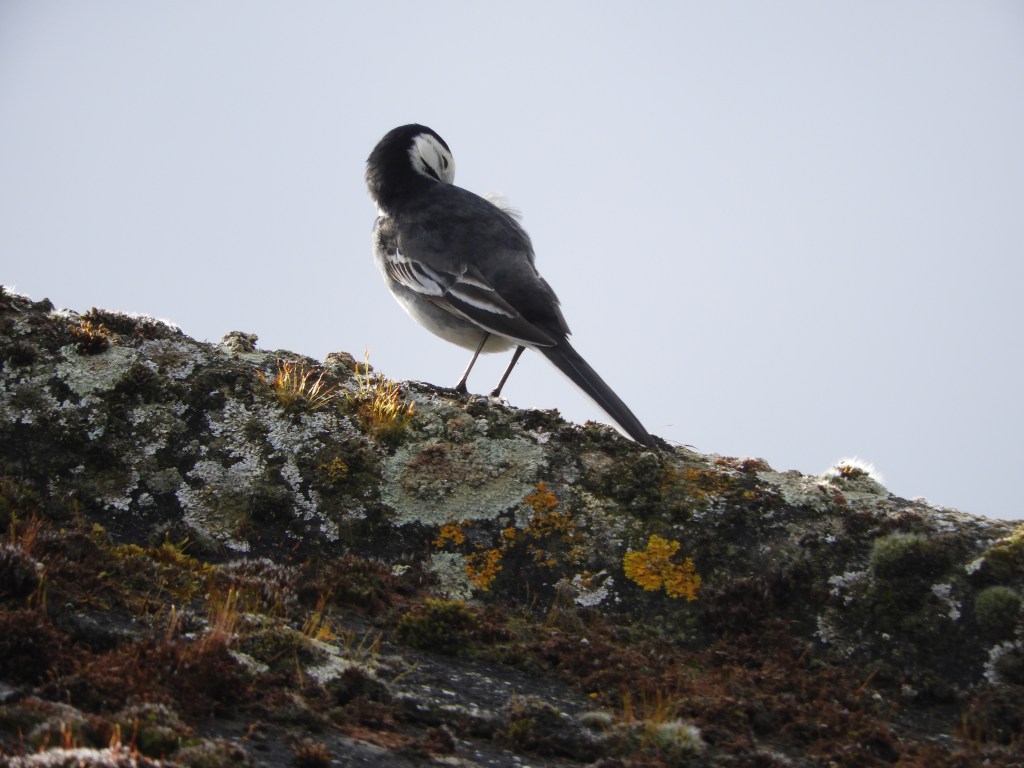
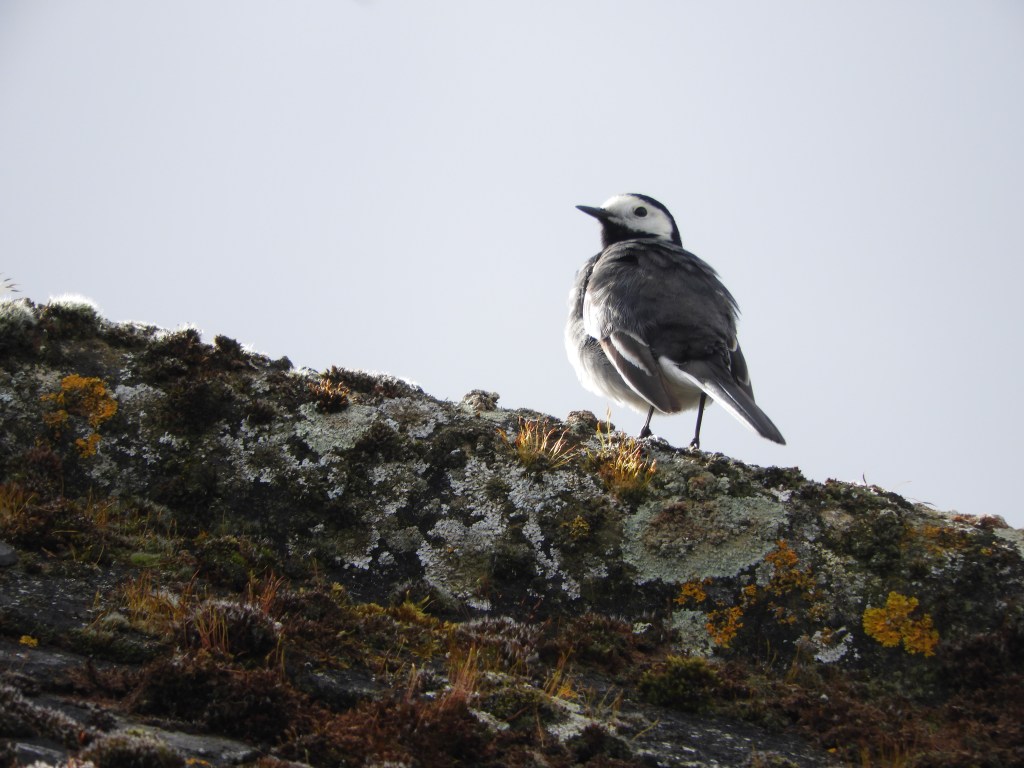
The White Wagtail which is the race alba is a frequent migrant of Continental Europe, grey rump, grey back, white/pale grey on the flanks and belly, sometimes can be confused with females of race yarrellii but can easier to identify in the Spring when the male has a defined line between black nape and the grey back. Unfortunately I do not have any White wagtail images but the female below would give you an idea on colouring to look for in a Male White wagtail the black bib on the front would be more defined into the grey and would extend up to the lower bill
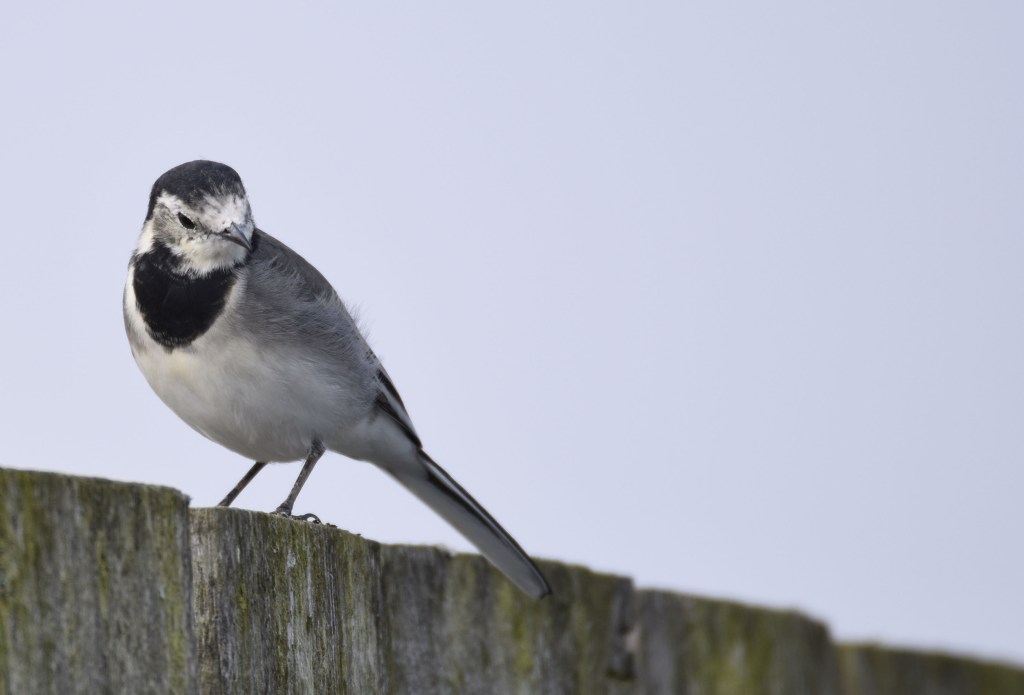
Pied Wagtail yarrellii female

The Grey Wagtail Motacilla cinerea is more associated fast running rivers, mill streams and clean rivers, in the Winter you have more chances of seeing them in the East Anglia where they will visit garden ponds and as I have seen them sewage works where insects are to be found on the filter beds. Do not be fooled by the name as this attractive bird is bright yellow underneath (sometimes mistaken as a Yellow Wagtail), the only wagtail with pale legs and the longest tail, slate grey above and yellow/green rump.

I have used an image of a young Grey Wagtail below, it is just getting the yellow below but this can be very vibrant on the adults in the Summer the male will have a black chin and the female will be white, some may think this young bird could be a young pied, but the main give away is the pale legs only found on the grey wagtail, all the other wagtails the legs are black.
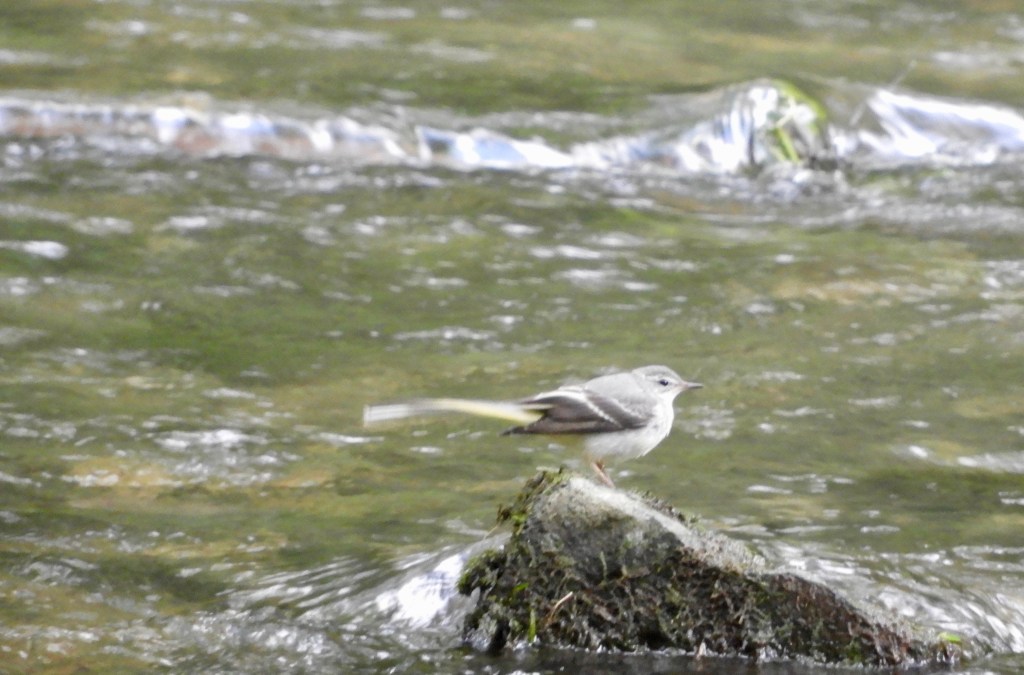
Young Grey wagtail, give away is the pale legs

The last wagtail you are likely to see in East Anglia and in large numbers especially near cattle is the Yellow Wagtail Motacilla flava this migrant will start appearing in April and will start to leave us in October, the race that breeds here in the summer is by far the most colourful, the British or Western Yellow Wagtail is race flavissima, Male is green above, Yellow face and underparts, female tends to be grey/ brown/olive above, yellow to buff underneath. They can be found in cereal fields, wet meadows and around cattle, usually seen running between the legs of the cattle as they stir up insects. there are various races of the Yellow Wagtail that you may be lucky enough to see, Blue-headed race flava is a one of the regular seen in Spring, Channel Wagtail which is a hybrid race flavissima/flava, Ashy-headed race cinereocapilla rare, Grey-headed race thunbergi rare, Black-headed race feldegg a vagrant. There is a very good article about Yellow Wagtails and how to identify the different forms in Birdwatch magazine May 2020 – issue 334 https://pocketmags.com/birdwatch-magazine.
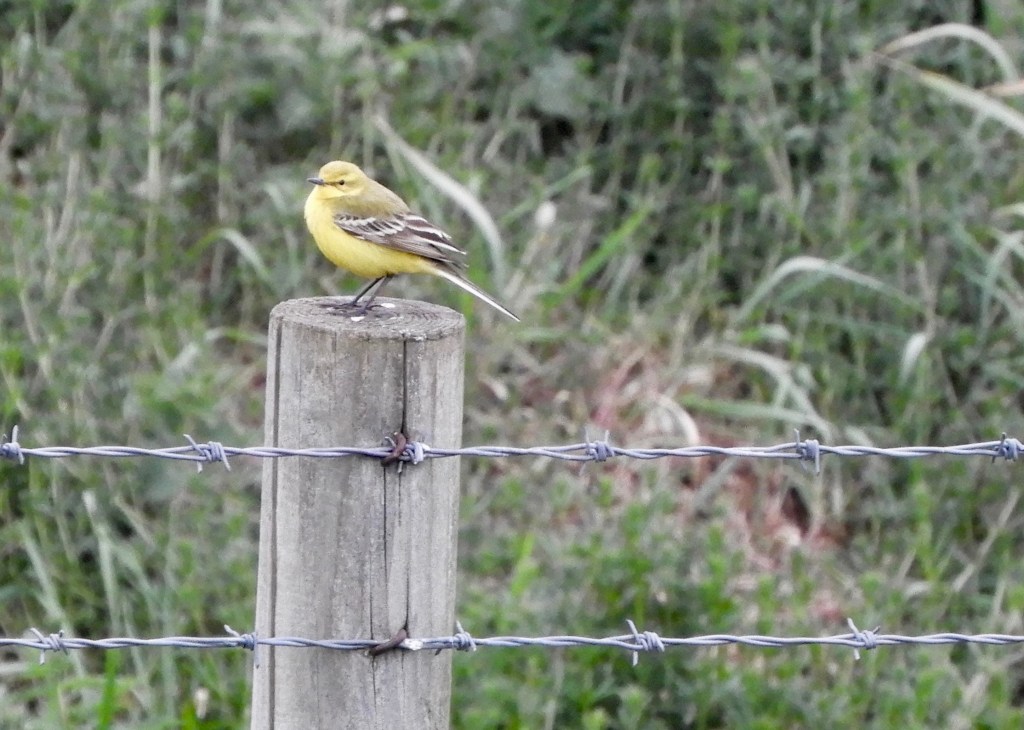
Yellow Wagtail

Hopefully this has given you an idea of the Wagtails you are likely to see in East Anglia and now is the time you have the chance to see a more rare race, just to give you an idea of your chances a couple of years back whilst I was at work I looked out of the window and counted about 37 Yellow Wagtails all running around the grass following the cattle, I joked with a volunteer we need to find a Blue-headed one amongst them, 5 minutes later I had found one.

References Britain’s Birds, An identification guide to the birds of Britain and Ireland, Hume, Still, Swash, Harrop and Tipling, published 2016 ISBN 978-0-691-15889-1
Daily walk

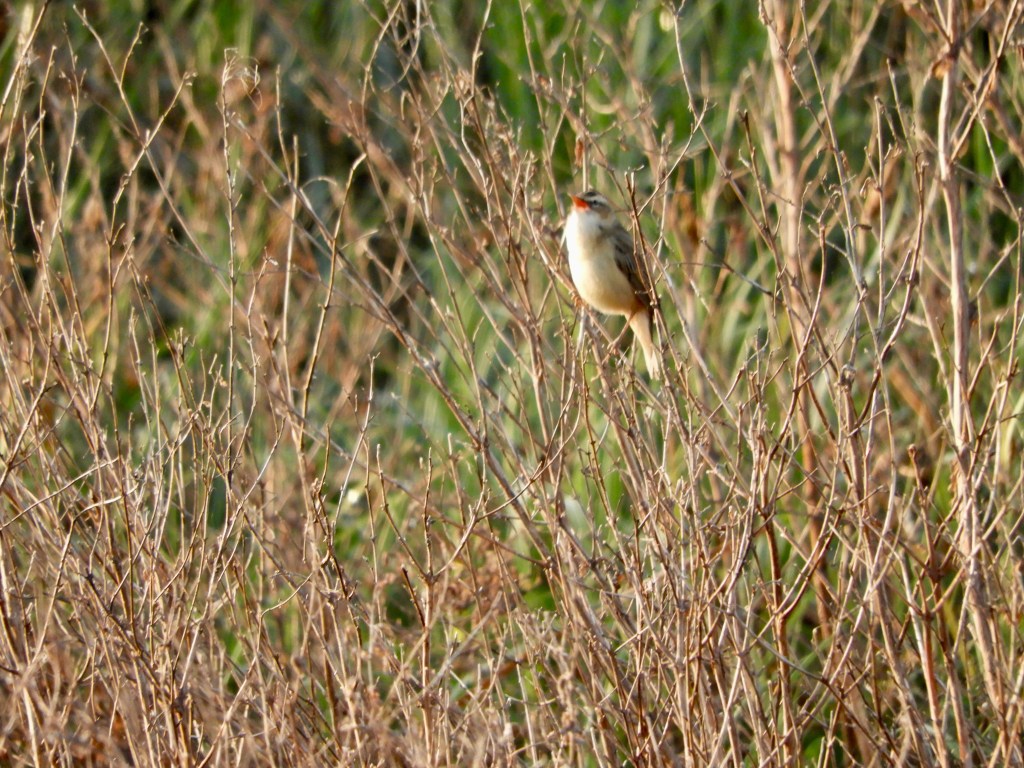
It may be starting to feel a bit like Groundhog Day with social distancing and only being able to have one period of exercise a day in the form of a jog, cycle or as in my case a walk incorporating the dog’s first walk of the day, but at least we have been blessed with dry and warm weather these past few days. As I said in my blog yesterday my daily route is now becoming bit of a ‘ Local Patch’ with me, however it does amaze me although the route is the same and in cases at the moment so are some of the birds, Sedge warbler, Reed bunting, Whitethroat and I have never had a year where I have seen so many Grasshopper warblers.

Sedge warbler today

But some birds and mammals are only making an appearance now and again, for instance there were no Roe deer today whereas I nearly always see at least two or three, for the second day in a row I saw Barn Owl but this is the only time in these last 14 days that I have seen two individuals, one of them appears to be slightly darker than the other and they were both hunting in separate areas.

Barn owl hunting

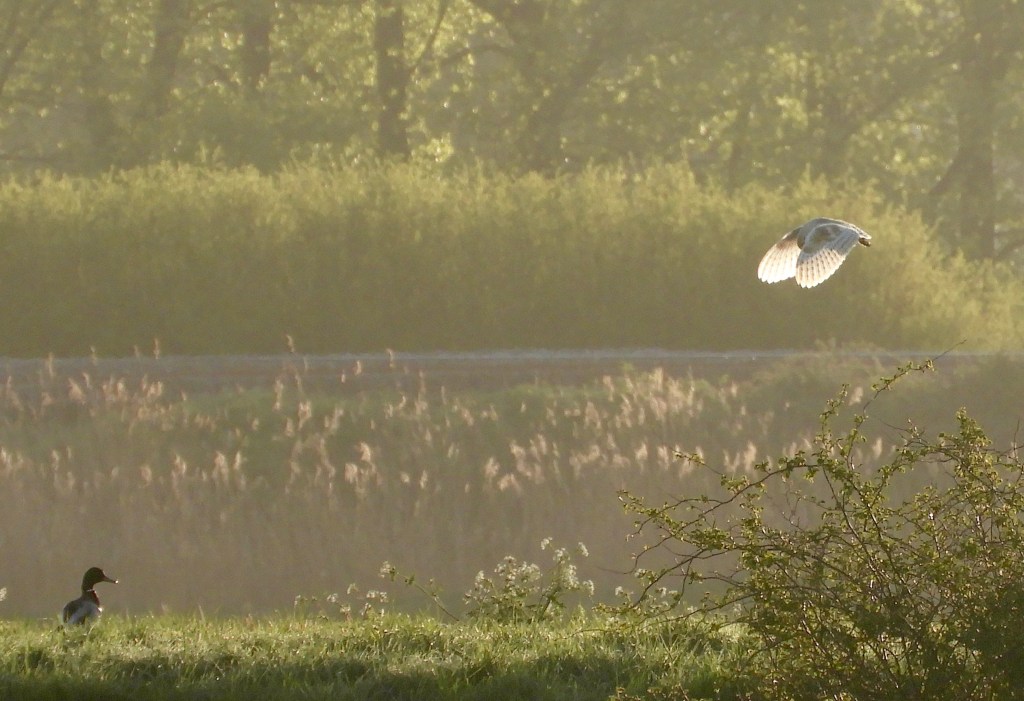
The first and lighter of the two Barn Owls was at the 2 mile mark on my route, almost ghost like in the morning light, at first it was ahead of me along the footpath flying low along the bank, twice it dropped down on to the ground, perhaps it had managed to catch a vole?, but it seemed to take off again with out any reward, it then crossed the river and started coming towards me on the opposite bank, as it was almost level with me I had to shield my eyes against the rising sun which highlighted the Owls wing feathers making it all the more ghostly, a mallard drake on the footpath seemed curious as to what the Owl was looking for.

Mallard and Owl

The Owl carried on North along the river looking for any movement below, it carried on until it reached the railway bridge then promptly turned and headed South again along the river, it paused at times in a slight hover and I watched it disappear along the opposite bank, I have been transfixed by the Owl and it was almost as if someone had turned a volume switch up as I became aware of the Sedge warblers and then a Grasshopper warbler.

Grasshopper warbler

This has almost become a daily game now locating the Grasshopper warbler, cup one ear, cover the other (stand on the dogs lead to make him stay) and located, there he was low in the vegetation turning his head from side to side, I am really loving this little warbler and I am wondering if this is a record year for them.

Grasshopper warbler singing this morning

We got to the bridge that goes over a small dyke after locating another Grasshopper warbler, this is the point we turn back (Sammy now anticipates this), on the way back the Whitethroats are singing to my left, the Sedge and Grasshopper warblers to my right, just up ahead the distant call of a Cuckoo but no appearance this morning, we walk back along the path stopping now and then to look, listen and take in the morning as another day gradually wakes up around us, we cross the railway line at the small gated crossing, there are linnets on the path just on the other side of the crossing and a Whitethroat sings in the brambles.

Whitethroat

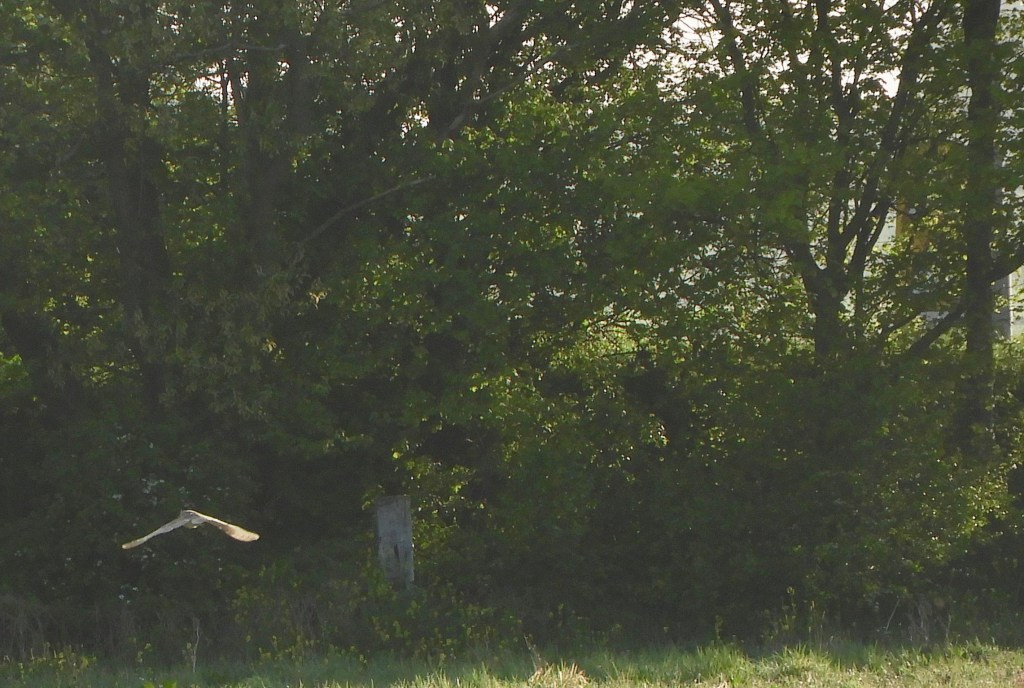
We carry on along the path to the new bridge that takes the Ely Southern bypass over the railway lines and the river, as we emerge from underneath the bridge and walk beside a fenced off area of reedbed there is suddenly an alarmed call from an unseen Water rail and infact all the Sedge warblers have stopped singing, all of a sudden from behind us and to our right a Sparrowhawk flies low lazily over the reedbed to sit in a tree on the other edge. I am now a mile or so from where we turned round and I have retraced our route out and as I look in the distance there is the second, darker Barn owl hunting, almost a copy of the the first Barn owl in it’s pattern of hunting, unfortunately this one is also on the opposite bank and further ahead, but I am able to get close enough to get a photograph before it disappears Northwards over the road and along the river.

The second Barn owl

All in all another good walk to lift the spirits and face another day in lockdown, it is true that nature does give you a lift and hopefully more people have engaged with the wildlife and countryside close to them and I hope that it continues when all this is over, so I look forward to tomorrow and my daily dose of ‘natural medicine’ via my ‘Local Patch’.

Our halfway point on our daily walk, where we turn around to retrace our steps.

Farewell to Summer visitors

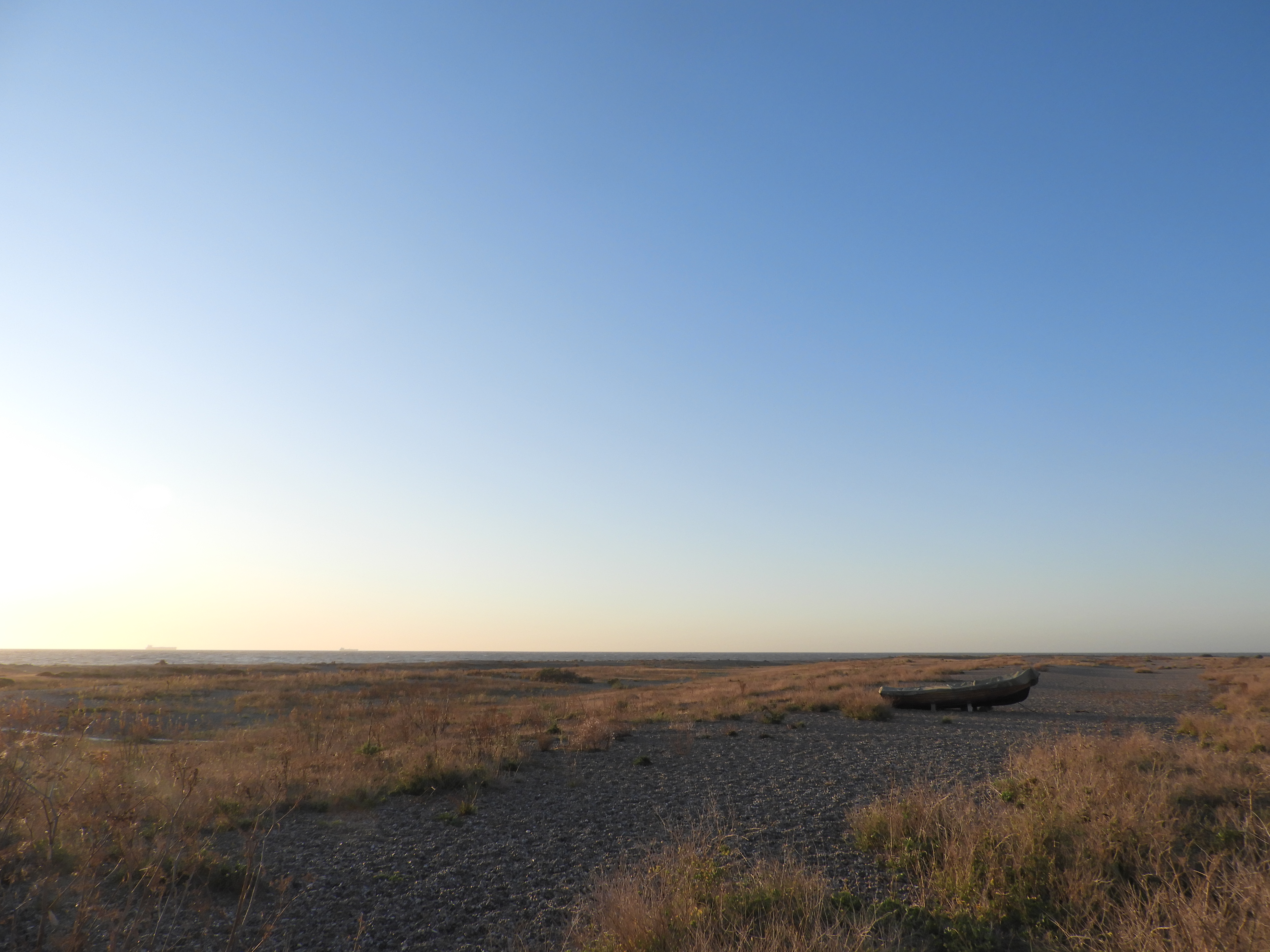
Does not seem possible last week saw me on the Suffolk coast and experiencing the last of the Summer with blue skies and 20c, it made the early morning walks along the beach that much more better for seeing flocks of linnets and migrating wheatears.

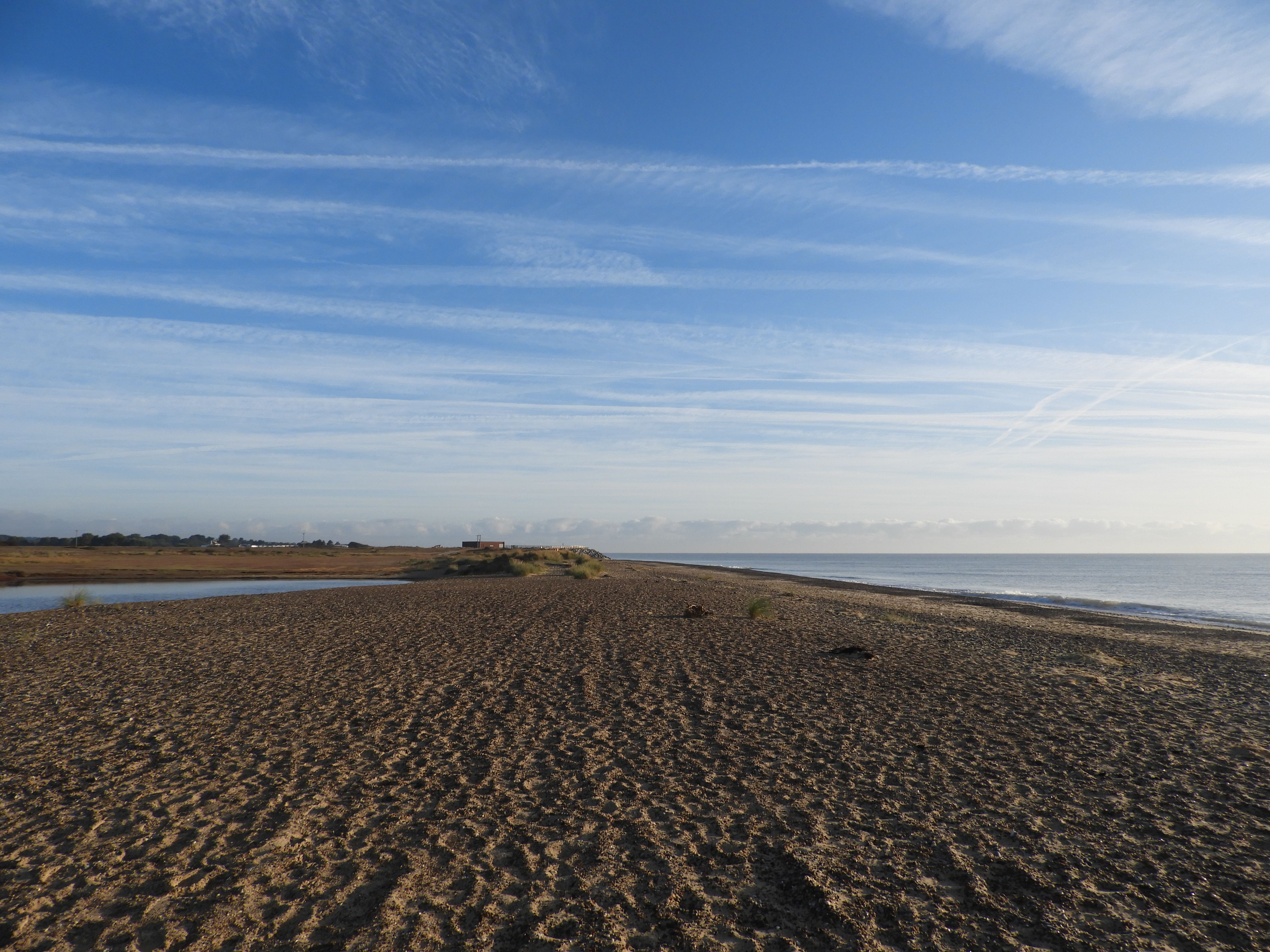
DSCN7910Looking south from Beanacre to Southwold

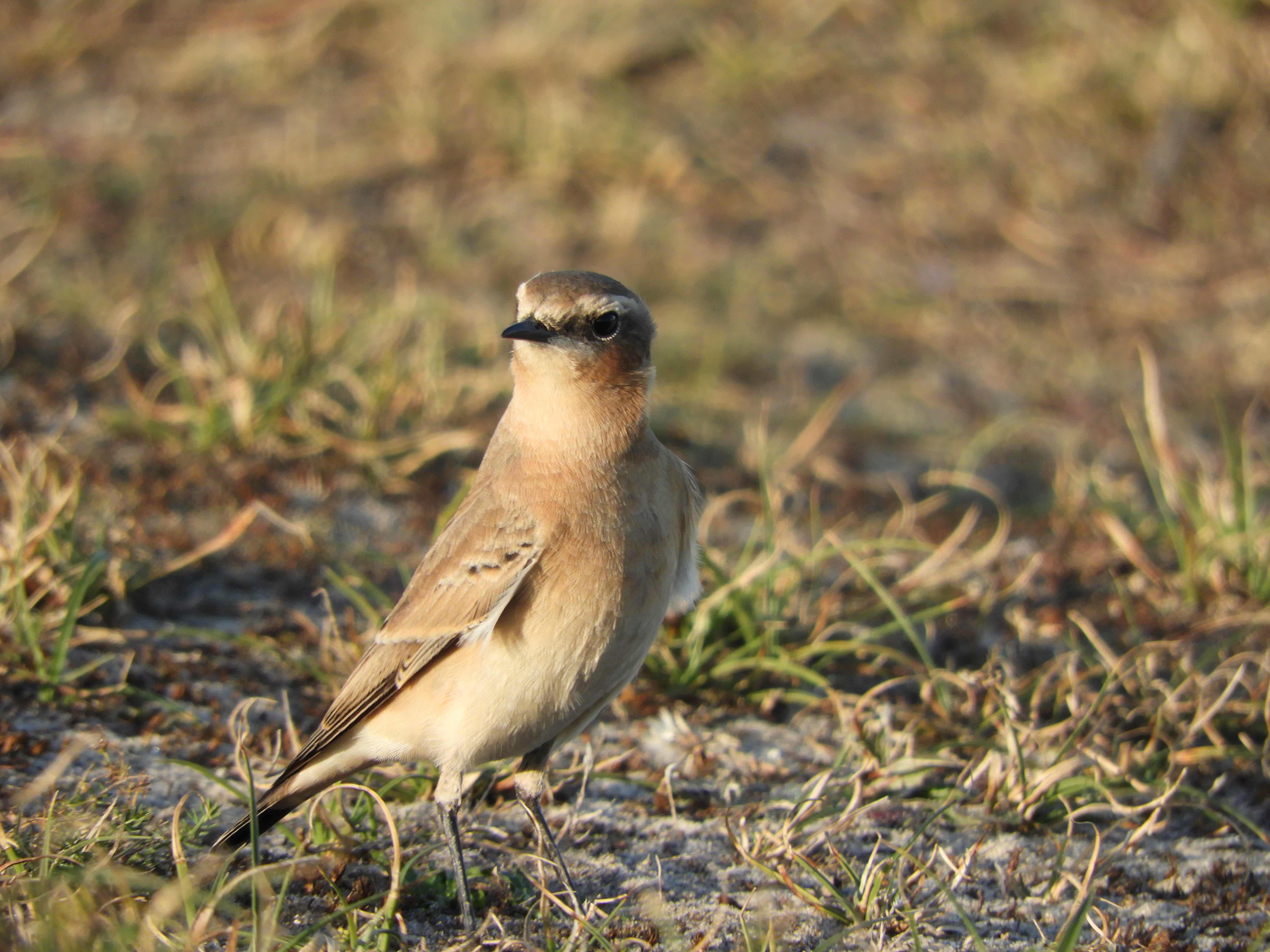
The first morning I encountered the migrating Wheatears was as I walked from Kessingland to Benacre with Sammy my border collie as we walked around the back of the small lake or Broad as it is known along the footpath amongst the bracken and ling you eventually have the option to get back on the beach which I usually do to head back to Kessingland, this morning as we approached the beach two Wheatear took off from the beach and flew South but  for a few metres before one of them suddenly stopped and suddenly started to hover, I had never seen them do this before and was amazed when the second one also joined it and started to hover as well, both were next to each other hovering for a minute or so before flying off south  along the beach.

I kicked myself for not having my camera ready to catch the hovering Wheatears, but ensured every time I walked along the beach from that morning to have my camera ready.

Although I never did encounter any more hovering Wheatear, I did see them everyday, from one or two every morning to up to three in the afternoon, some Male and Females and Juvenile obviously all on their migration South.

DSCN8000Wheatear

Every morning I saw lots of Swallows and House martins gathering on the telegraph wires on the campsite I was staying, a couple of morning there was panic amongst these birds as a Sparrowhawk would come in from the East with the rising Sun behind it, I saw this happen at about the same time every morning, usually an unsuccessful raid by the Sparrowhawk who always ended this flight by seeking cover in the same tree. One morning I saw a Hobby heading inland from the beach obviously using the same tactic of the rising Sun behind it to surprise prey. These were just two of the dangers the Swallows and House martins are sure to encounter on their migration but hopefully they will survive to return next year.

It was with a heavy heart I had to return home from my few days back home on the Suffolk coast, and all the more tinged with sadness as on that last morning there were no Swallows or Martins on the wires, it was as if we had all managed to enjoy those last rays of Summer and said farewell to our Summer visitors until next Spring, but now as Autumn settles in we can look forward to saying Hello to our Winter visitors as the arrive to enjoy out more ‘Mild’ Winter.

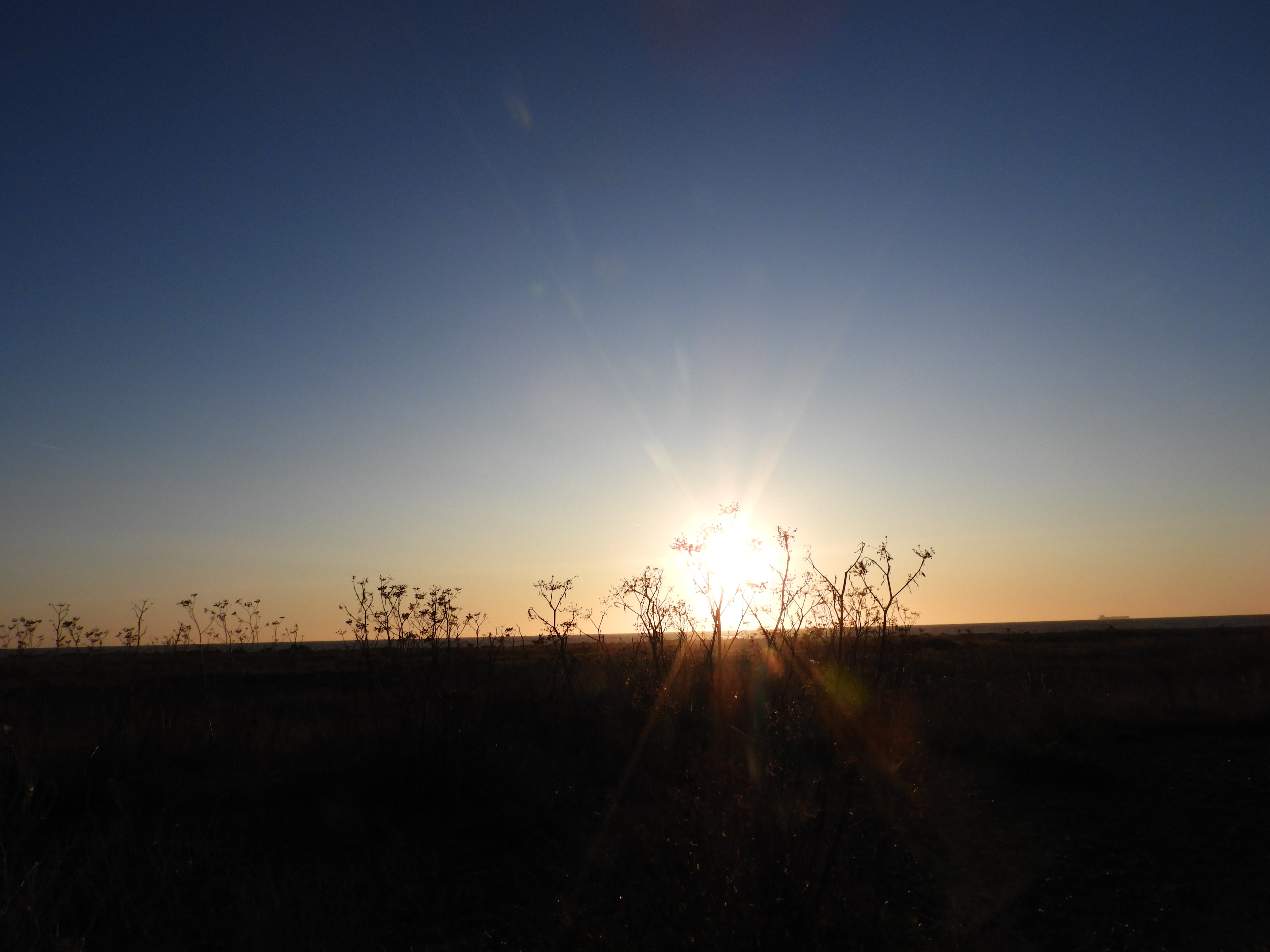
So it only leaves me to share with you a few images of the last Rays of Summer on the Suffolk coast.

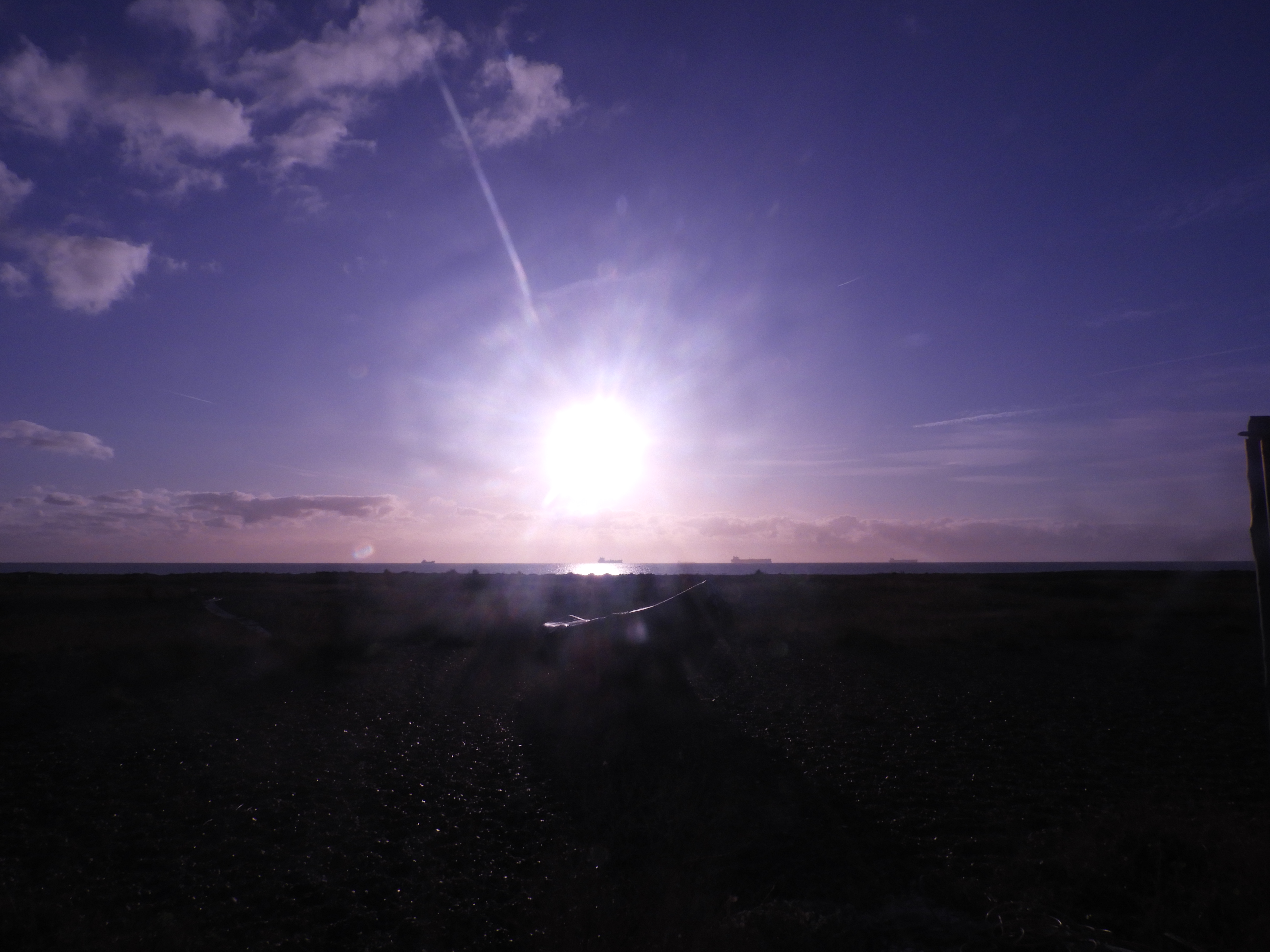
DSCN7906Sunrise from Kessingland
DSCN7798Benacre looking North to Kessingland
DSCN8081 Kessingland beach
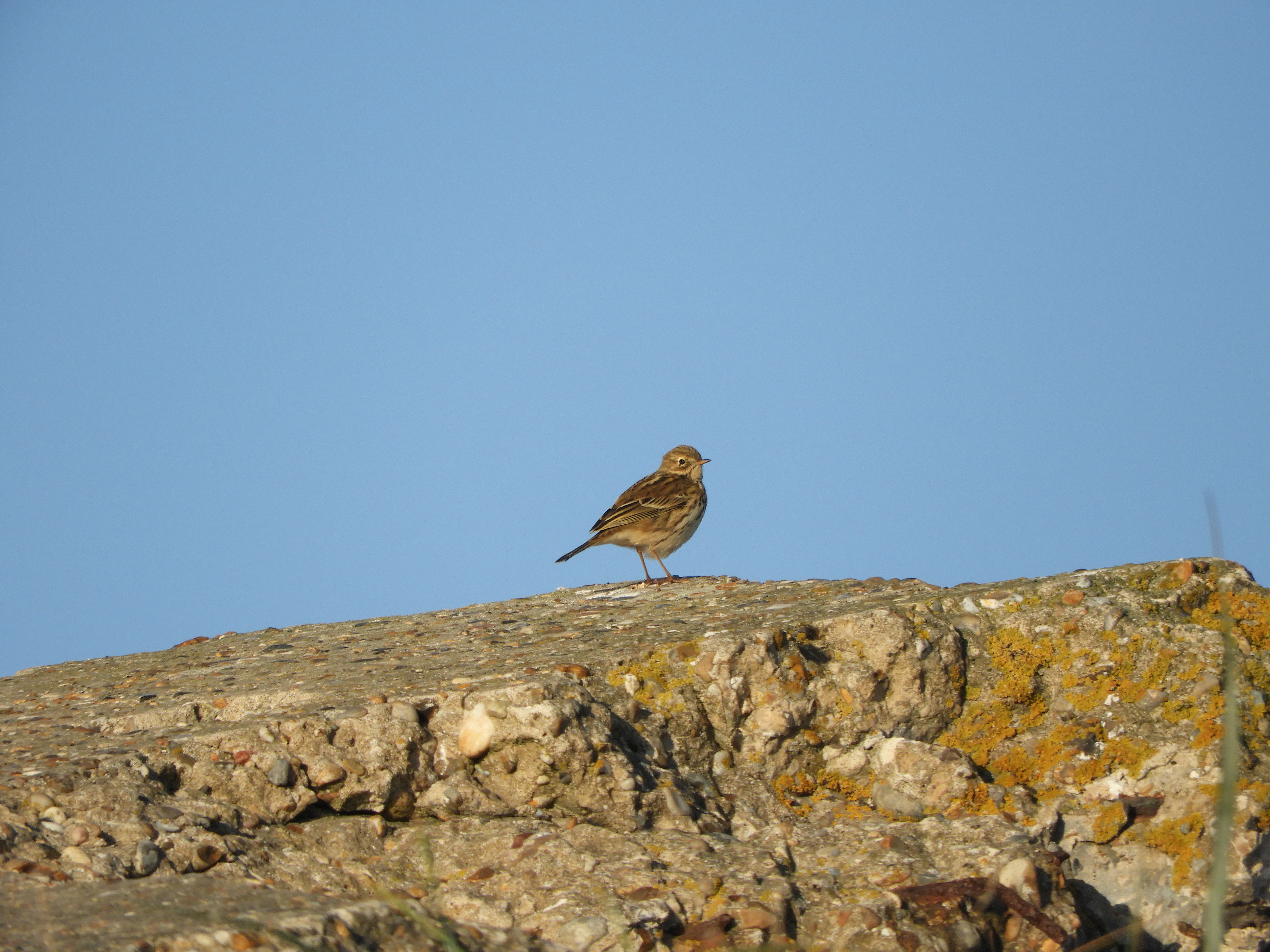
DSCN8012Meadow pipit
DSCN8060Wheatear
DSCN8006Wheatear

DSCN8082

East Anglia a region of variety

I have just spent a few days in North Norfolk and whilst there it confirmed to me what a great part of the British Isles we have here not only for living and working but also for pastimes.

For example the wildlife and in particular the bird life.

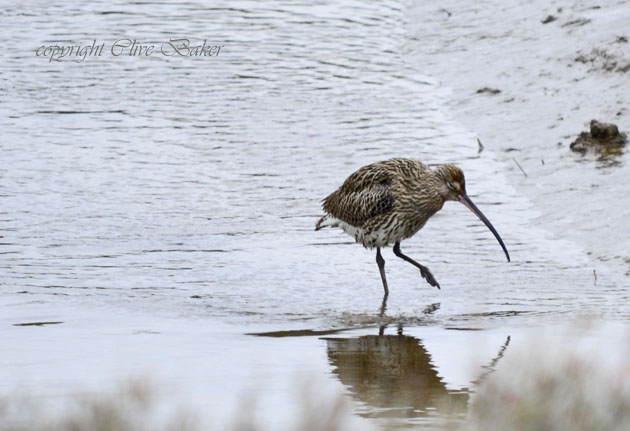
Wading bird with long curved down beak

Curlew at RSPB Ticthwell, North Norfolk

there are a number of nature reserves all over East Anglia and North Norfolk is one of the hot spots for seeing wading birds, with the RSPB reserves at Titchwell and Snettisham.

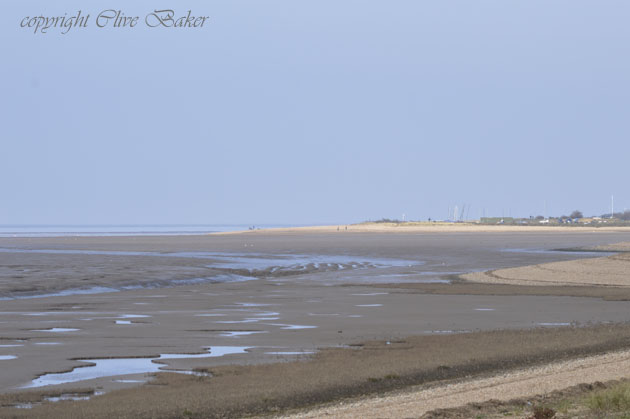
Vast beach

The Beach at Snettisham, a hotspot for seeing large flocks of wading birds.

Not only are there vast beaches but also woodland that attract walkers all year round and also sports events like Orienteering, sometimes these woods can be magical at first light all the more so in spring when they echo with birdsong.

light and shadow in woodland

First light on a spring morning in woodland at Sandringham

It is not only the people who live or visit the region that enjoy it but the animals they bring with them, horses and dogs love the freedom of the beach and the many footpaths.

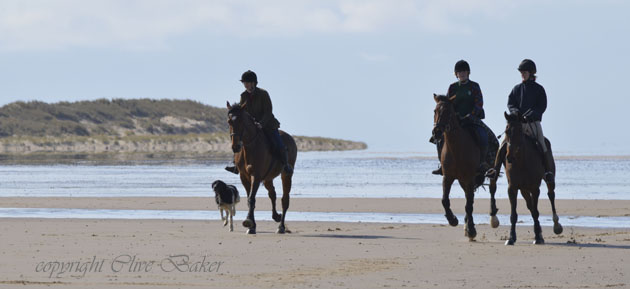
Three girls on horseback with dog running on beach

Horse riders and pet dog gallop on Holkham Beach

From beach to woodland, there are many places in our region to enjoy at a gallop or just an easy walk, if paradise was East Anglia I would go tomorrow.

Three walkers on beach

A gentle walk on Holkham beach, Norfolk

Spring in my step

Unfortunately my website blog has had to take a back seat these last few weeks due to my wife having an accident, so family life has been priority these last 4 weeks, she is recovering well and I feel now we are into Spring and we have had a few warm sunny days this has helped her recovery and lifted not only hers but everybody’s spirits.

You only have to walk in the East Anglian countryside at the moment at any time of the day and the birds are singing (I heard my first chiffchaff today) and flowers are opening, blossom is out on the trees and I have even seen hawthorn leaves starting to open.

In the spare hours I have had I managed to get out and take some images, so I shall share a couple here today.

But as a warning in about the weather we are not quite out of the woods yet, I can see in my copy of the book ‘ The Carlton Colville Chronicles of Canon Reginald Austus Bignold ‘ the Canon had entered March 19th 1915 It has been snowing heavily for twenty-four hours “, Well 100 years ago it may have been but you never know.

Round spiky seeds hanging down from branches

The seeds of a plane tree against the Spring sky

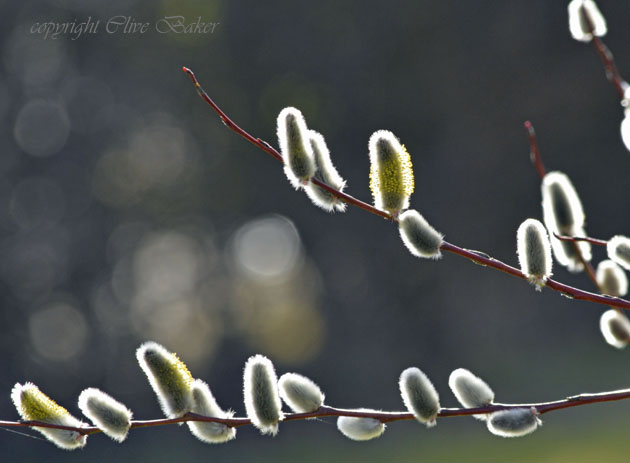
Large catkins backlit by sun

Catkins of the pussy willow

Two heads of reedmace

Reedmace often called bulrush by mistake

Male Blackbird on branch

Male Blackbird one of the many birds singing early in the mornings in Spring.

The Spring Collection

This last weekend saw the East Anglian counties touched by the first taste of Spring, a Sunny day and warmth in the Sun not only brought out the sound of lawn mowers but sightings of Brimstone and Peacock butterflies, even the odd Queen bumblebee out of hibernation from the old mouse-hole where she would have spent the winter.

But if you have not heard it is the birds that are hailing that the days of Spring are on the way, Song thrush, Robin and Blackbird are the early risers singing their hearts out in the darkness before dawn to be joined by dunnock and wren as the sun creeps over the eastern counties.

And whilst many a bird watcher is waiting for the Spring migrants to arrive our own resident birds are displaying not only their fine voices but also how splendid they are looking in their plumage  in a few months the chores of raising a family will leave them looking not so fine and dandy, but for now enjoy our wildlife as they prepare for Spring and as a taster here is  just some of the birds displaying their Spring collection on natures ‘Catwalk’

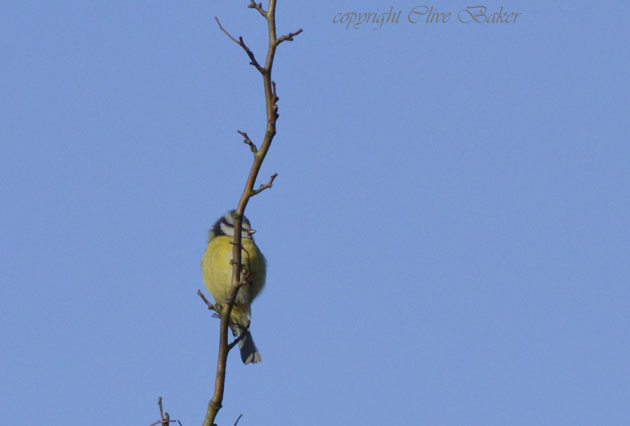
Blue tit singing

Blue tit

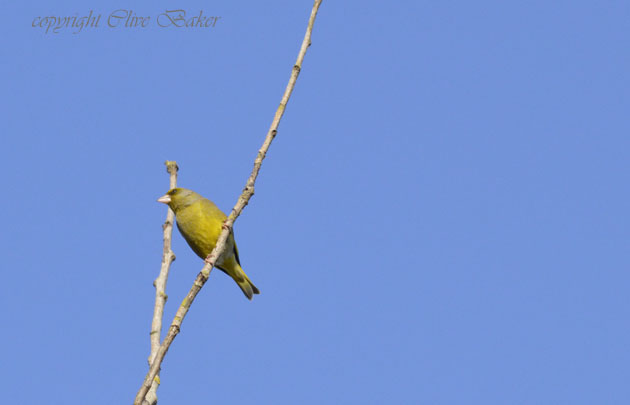
Greenfinch Singing

Greenfinch

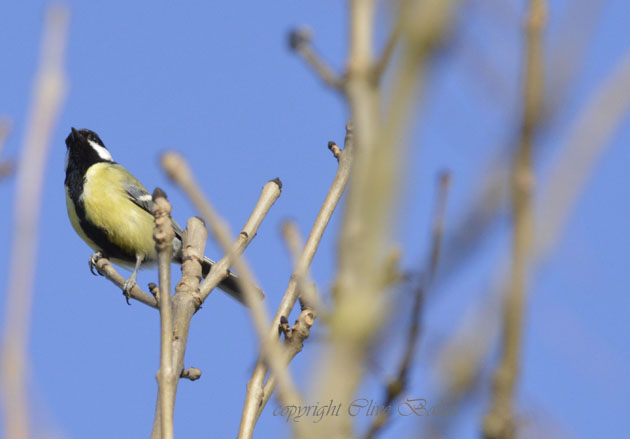
Great Tit singing

Great Tit

Robin singing

Robin

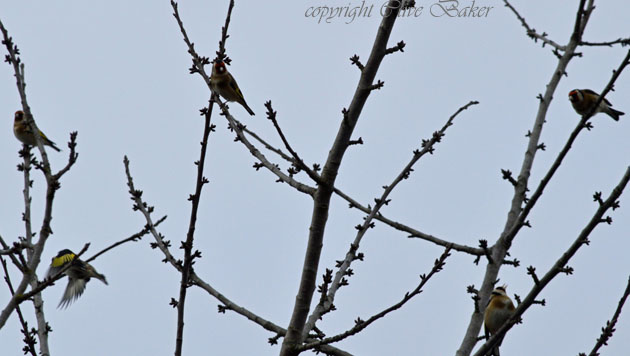
Flock of Goldfinches

A charm of Goldfinches

View from the train

I am always amazed at what you can see when traveling by train, I am also amazed at what most of the other travelers miss.

Take this week on my 20 minute train journey from Ely to Cambridge I can get quite a total on my list, it is almost like traveling in  a mobile hide so far on Monday’s journey home I listed 1 buzzard, 12 roe deer, flock of fieldfares, 1 marsh harrier and 1 female merlin.

The following morning, two roe deer, 1 barn owl, in the evening trip home, roe deer and marsh harrier, this morning 1 buzzard, 1 barn owl, now take in to account it is only just getting light by the time we are approaching Cambridge in the mornings I am expecting the list to get better as the mornings get lighter.

I am sure there is more that I miss, but I always enjoy my train journeys as I can wildlife spot even if the train can be a bit packed.

Common Buzzard in Flight

Common Buzzard

Birds behaving badly and Strangely

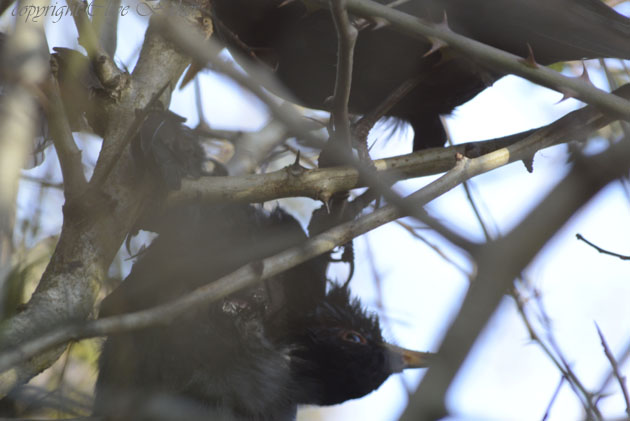
Yesterday morning I was walking the dog when I heard the sound of a blackbird it was the alarm call but seemed quite slow and low in looking closer into the hedge I could see it was two males and the one making the sound was stuck by its wing in the branches of the hedge.

Two male blackbirds

Two black birds in hedge

At first I was thinking that one bird was trying to release the other but could see the upper blackbird was attacking the one stuck and was trying to peck at its eyes.

Male blackbirds fighting in hedge

The upper blackbird was getting the upper hand

This was obviously Male blackbirds fighting to establish a territory or one of the males defending its territory, as we are getting near the nesting season I was guessing this was more to do with breeding than over food, the upper bird flew off when it saw me and the bird stuck in the branch was looking exhausted.

Lone blackbird stuck by wing in hedge

The Stuck bird was exhausted.

The bird hung there by its wing and after a while it started to breathe heavily, once or twice it tried to free its self and soon became weaker, I am afraid I could not leave it there but it was hard to reach but with the aid of a stick I managed to move the bird upwards and it flapped about as I tried to free it, I did succeed and it half flew and half fell into the garden beyond, I do not know if it survived but I gave it half a chance.

Nature can be cruel at times and birds will fight to death over territory, but sometimes they can be amusing like the blue tit that insists in coming in to our garden and for the last two years has been attacking or courting I am still not quite sure its own reflection in a window, I have managed to get this on film and excuse me at the beginning but wait 40 seconds for the blue tit to appear and you will see what I mean.

Wicken Fen

Today I had a day off work an appointment in the morning but the afternoon was free, so I decided to have a walk around Wicken Fen, it was a dull day and the light was really low, but it is always a joy walking round what is the oldest nature reserve.

As I left the car park and walked down the track past the centre I could see lots of birds on the feeders, including a male and female mealy (common) redpoll the male already showing its breeding colours having a red tinged breast, slightly larger than the lesser redpoll which you are more likely to see in the Summer, I was lucky to see these two birds as there are usually only about 310 birds in the winter and only 3-4 breeding pairs in the Summer.

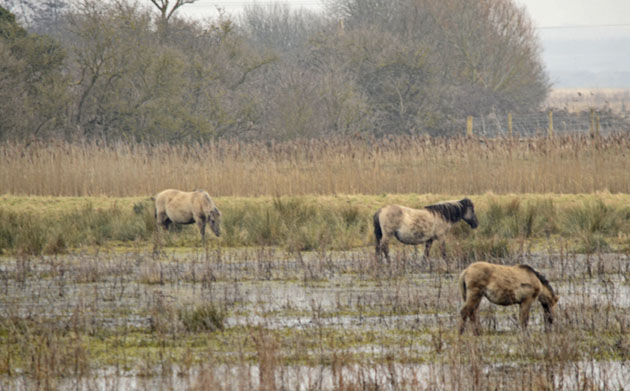
As I walked round the fen I was soon away from any walkers and regretted not wearing any gloves as it can get cold out here, I could see the Konik ponies on the fen, used here as they tend to feed on young trees and scrub and in doing so they are keeping the fen as it should be.

Threes ponies feeding in very wet conditions

Konik ponies grazing on the fen at Wicken

I stood and watched for a while and took in how quiet it was, no sound of Traffic only the wigeon whistling on the fen.

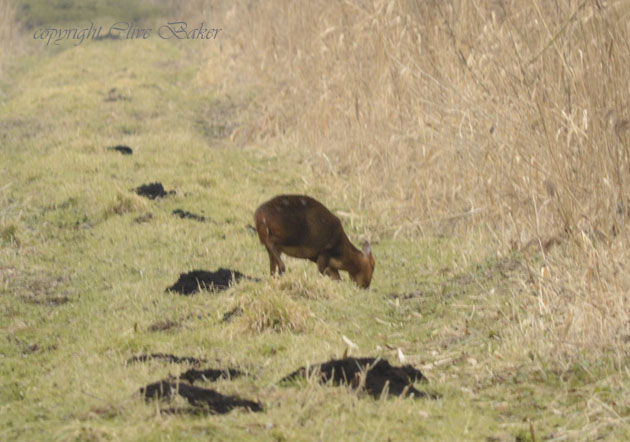
As I turned up the track I could see in the distance a Muntjac deer grazing on the track, there were more Konik ponies grazing in another field I stood here a while when suddenly a barn owl seemed to fly from nowhere, un seen by me it had been sitting on a low branch at the side of the field as when it had finished it’s hunting it returned there.

Barn Owl flying low over a field

the sudden appearance of a hunting Barn Owl

I watched the Barn Owl hunting for a while and decided to carry on up the track, The Muntjac was unaware of me and carried on grazing I managed to get close.

Small deer feeding on track

Munjac was unaware of me as I walked along the track

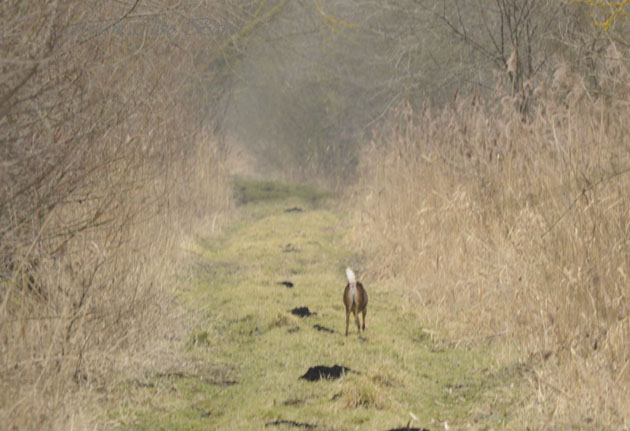
I wondered how close I could get, but all of a sudden it heard me and sprinted off up the track tail up and soon disappeared into the reedbeds.

Deer running tail up in the air

The Muntjac takes flight

I was now turning back towards the main centre as I walked along Wicken Lode, but I could just make out something in the red beds in the distance and using my scope I could see a male Marsh Harrier sitting on a post turning its head looking from side to side the eyes not missing a thing, I watched him for a while until he flexed his wings once or twice then he took to the air flying over the reeds and away.

All in all for such a cold grey day there was lots to see, even if my hands were cold.


After the cold

After a week of ice, snow and sleet there were signs that we may be heading to a warm spell, the wind still has an edge but there seemed to be a lot of activity in the natural world.

Squirrels were digging up their hoards of  nuts buried in the Autumn and now easier to dig up as the frozen ground begins to thaw.

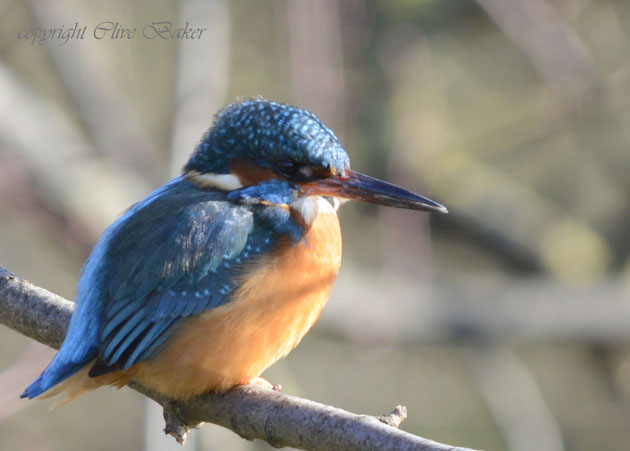
Kingfisher on branch

Kingfisher waits in the Winter Sunshine for a fish to pass by in the water below.

The Kingfisher has returned to the now unfrozen stream to catch fish that had been protected by the ice that had covered the water below.

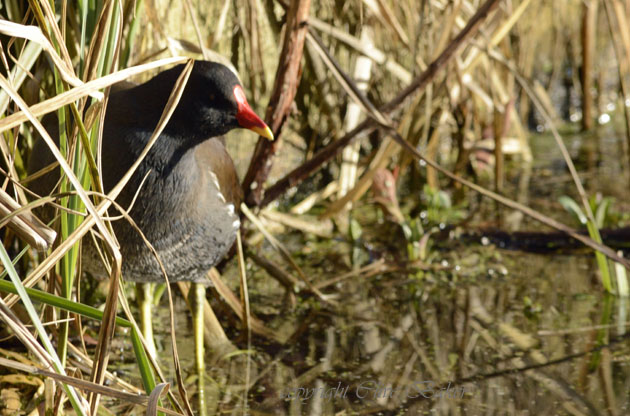
Moorhen on the edge of reeds

Moorhen in the reeds

The moorhens now patrol the reedbeds, their yellow and red bill brightens up the gloom of the reeds at it catches the sun.

Bird bathing

Song thrush washes itself in the stream

And birds like the Song thrush takes advantage of the water to have a bath in the stream.

If anything it proves how much the wildlife depends on water as we do for life and as the sun shines dare we start to think of Spring?