Wicken Fen

Today I had a day off work an appointment in the morning but the afternoon was free, so I decided to have a walk around Wicken Fen, it was a dull day and the light was really low, but it is always a joy walking round what is the oldest nature reserve.

As I left the car park and walked down the track past the centre I could see lots of birds on the feeders, including a male and female mealy (common) redpoll the male already showing its breeding colours having a red tinged breast, slightly larger than the lesser redpoll which you are more likely to see in the Summer, I was lucky to see these two birds as there are usually only about 310 birds in the winter and only 3-4 breeding pairs in the Summer.

As I walked round the fen I was soon away from any walkers and regretted not wearing any gloves as it can get cold out here, I could see the Konik ponies on the fen, used here as they tend to feed on young trees and scrub and in doing so they are keeping the fen as it should be.
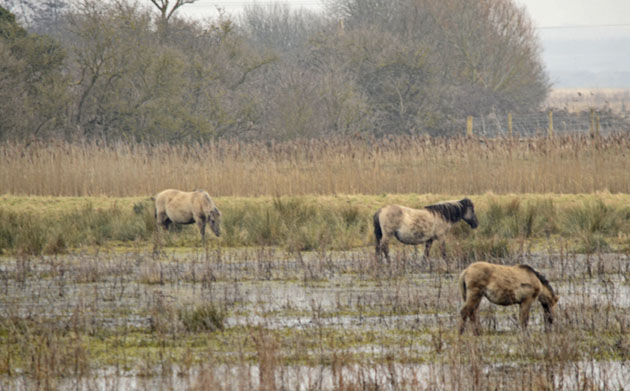
Threes ponies feeding in very wet conditions

Konik ponies grazing on the fen at Wicken

I stood and watched for a while and took in how quiet it was, no sound of Traffic only the wigeon whistling on the fen.

As I turned up the track I could see in the distance a Muntjac deer grazing on the track, there were more Konik ponies grazing in another field I stood here a while when suddenly a barn owl seemed to fly from nowhere, un seen by me it had been sitting on a low branch at the side of the field as when it had finished it’s hunting it returned there.

Barn Owl flying low over a field

the sudden appearance of a hunting Barn Owl

I watched the Barn Owl hunting for a while and decided to carry on up the track, The Muntjac was unaware of me and carried on grazing I managed to get close.
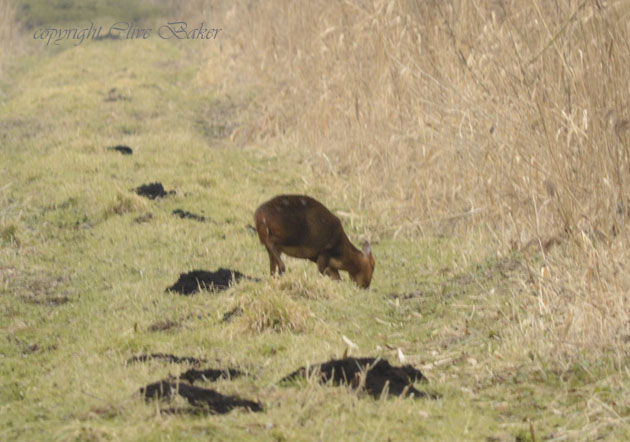
Small deer feeding on track

Munjac was unaware of me as I walked along the track

I wondered how close I could get, but all of a sudden it heard me and sprinted off up the track tail up and soon disappeared into the reedbeds.
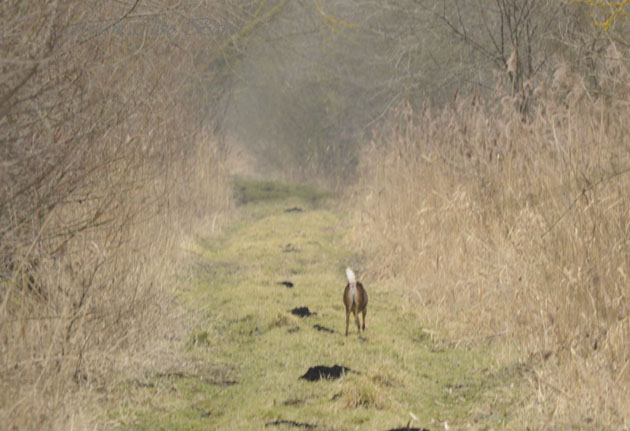
Deer running tail up in the air

The Muntjac takes flight

I was now turning back towards the main centre as I walked along Wicken Lode, but I could just make out something in the red beds in the distance and using my scope I could see a male Marsh Harrier sitting on a post turning its head looking from side to side the eyes not missing a thing, I watched him for a while until he flexed his wings once or twice then he took to the air flying over the reeds and away.

All in all for such a cold grey day there was lots to see, even if my hands were cold.


Sounds and Signs of Spring

We could almost be lulled into a false sense that Spring is just around the corner, the Sun has been out and the temperature  is double to what it was this time last week, add to that the birds are singing louder and I heard the sound of a woodpecker drumming on a tree today all the signs seem to be there, in a secluded spot where I could see beehives the honey bees were swarming around the hives another sign surely?, snowdrops are in flower, aconite carpet the ground and there is even the odd daffodil in bloom all there for the bees to feed on, but we all know at this time of the year the weather can turn on its head in a moment, in shaded areas there are small patches of snow, and old saying “If the snow lays there it is waiting for more” could be true.

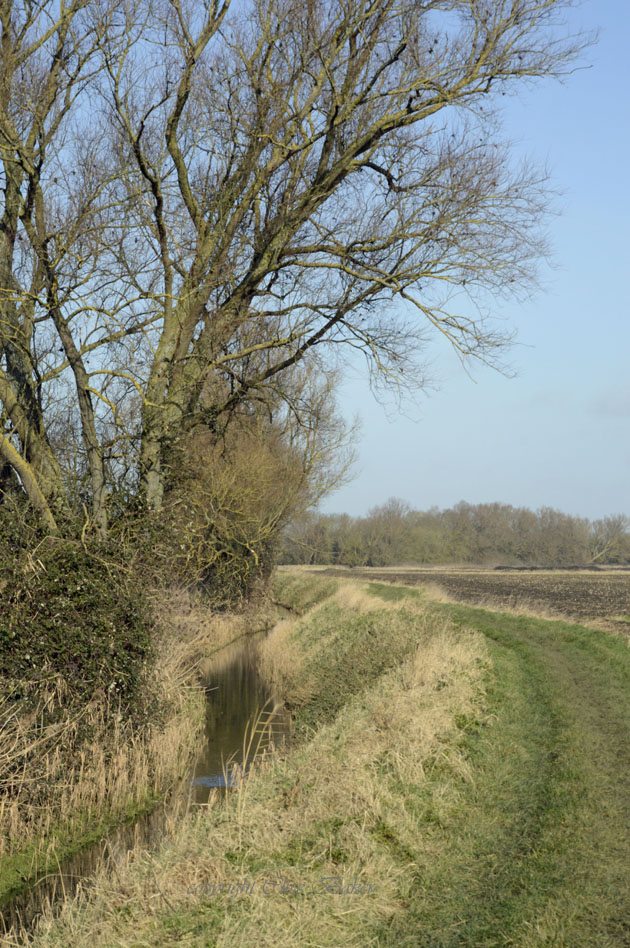
Country track by a stream

Walking the East Anglian footpaths.

But when the sun shines and the skies are blue, the birds sing and the spring flowers appear, I will keep thinking Spring is just around the corner.

After the cold

After a week of ice, snow and sleet there were signs that we may be heading to a warm spell, the wind still has an edge but there seemed to be a lot of activity in the natural world.

Squirrels were digging up their hoards of  nuts buried in the Autumn and now easier to dig up as the frozen ground begins to thaw.

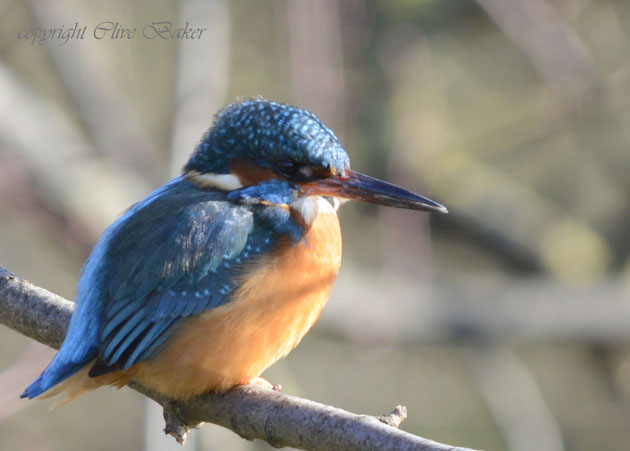
Kingfisher on branch

Kingfisher waits in the Winter Sunshine for a fish to pass by in the water below.

The Kingfisher has returned to the now unfrozen stream to catch fish that had been protected by the ice that had covered the water below.

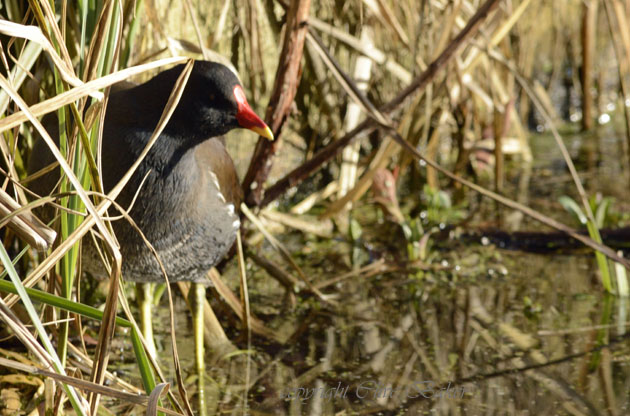
Moorhen on the edge of reeds

Moorhen in the reeds

The moorhens now patrol the reedbeds, their yellow and red bill brightens up the gloom of the reeds at it catches the sun.

Bird bathing

Song thrush washes itself in the stream

And birds like the Song thrush takes advantage of the water to have a bath in the stream.

If anything it proves how much the wildlife depends on water as we do for life and as the sun shines dare we start to think of Spring?


Muriel’s Meadow

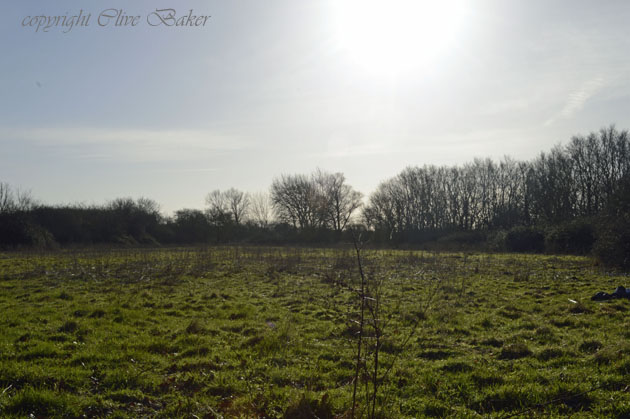
Today was quite a busy day, started early with a work party and some conservation work on a meadow managed by the Wildlife Trust, Muriel’s meadow is one a several meadows that make up Chettisham meadows near Ely, not ploughed as the soil was too heavy, although Chettisham Meadow which is owned by the Wildlife trust shows evidence of medieval ridge and furrow, so obviously ploughing was tried.

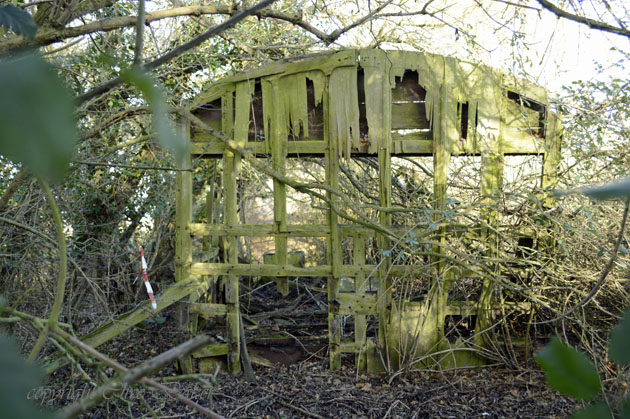
Muriel’s Meadow is named after the lady who used to live there in an old railway carriage as a child with her parents, life must have been very hard and basic as it is at least 20 minutes walk from any road then it must be at least four miles to Ely. The railway carriage is still there but is in a very bad condition but I believe Muriel is still alive and she has asked the carriage is not removed.

grass meadow

View of Muriel’s Meadow

Old railway carriage is disrepair

The Old Railway carriage where Muriel lived with her parents

It was a fantastic bright and sunny morning and there was still ice on the puddles, the birds were singing and our job was to start clearing back the brambles by about 2 feet  so plants can grow back, we will eventually over time clear the brambles back but by doing it gradually it gives plants a chance to establish.

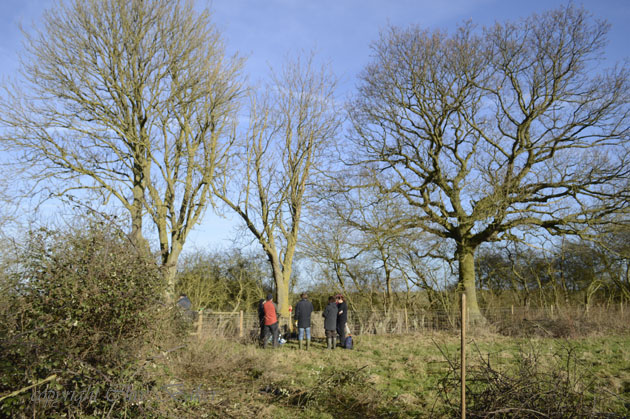
Standing by the big trees

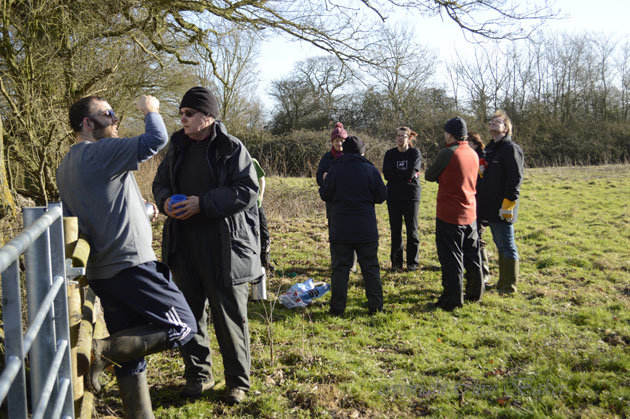
Time for a break and tea

Goupr standing round drinking tea

A well-earned brew and a chat after clearing the brambles

The can be nothing better than working outside on such a wonderful Winters day.

Next It was off to Welney and taking the hare walk and then the swan feed and talk, full number of people booked on the walk, then the largest number of people for the swan talk at 150 in the observatory, so many in fact I had to go out again and do another feed so those at the back got a chance to see what I do.

All in all a very satisfying day.

History in the Landscape

In this day of the internet and e-mails are we in danger of not recording events that have an impact on our landscape that may local to where we live, the world has been made smaller by the World Wide Web, but 100 years ago recording events local and national was by ink and paper, by newspapers or by people keeping diaries.

I mentioned in an earlier Blog Canon Reginald Augustus Bignold (1860-1944) Rector of my home village of Carlton Colville in Suffolk, from 1898 to 1944.

Canon Bignold made a diary that he had written in the fly leaves of the Parish Records and give an insight into the village and the effect the First World War had on it, the villagers and Canon Bignold himself, discovered in 1971 by the then rector of Carlton Colville the Rev. Frank L Thomas and later published as a book by J.R. Goffin, ‘The Carlton Colville Chronicles gives us an insight in to the life of the people of a small rural community on the Norfolk / Suffolk border, near to the coast their lives revolved round the sea, land and a war in a far off land.

Now when I return to the village of my birth it is hard to tell where the village ends and the start of the town of Lowestoft begins, I could still point out where the old black smiths once stood, the church and rectory still stand and where cows once grazed in the fields round the old Hall now stands modern houses and thanks to this book I can now see the village as it was 45 years before I was born there.

Cover of Book

The Carlton Colville Chronicles, copyright Parochial Church Council of St.Peter’s Carlton Colville

For example on this day 100 years ago Canon Bignold wrote:

January 19th 1915 ‘Bombs dropped from airship on Yarmouth, The house in the village were much shaken’ (Carlton Colville is 12.9 miles from Great Yarmouth)

He continues ‘Two hundred and thirty of our men have joined H. M. Forces. I have gazetted Temporary Chaplain of the 25th London Cyclists Battalion’

(copyright Parochial Church Council of St.Peter’s Carlton Colville)

So just from that small entry over 100 years ago we have a small window on the past, the horror of the first bombs dropped from the air on civilians, the numbers of men joining up and the vision of men going to war on bicycles

The are on the World Wide Web, sites that are recording the past and I am sure there are many on East Anglia, so as i now live Cambridgeshire in the West of the region here is a link to Ely, memories of Ely Pits and Meadows

So next time you are in the countryside and looking at a pond, it may just have been created by a bomb dropped from an airship over a hundred years ago, somewhere they may be a record of this.

Hare today

Yesterday I was leading the Hare walk  at WWT Welney as a volunteer I usually do the guide in the hide, swan feeds and the hare walks.

I like the hare walks because you get to see the hares running around, boxing or just keeping low and making an escape when you are nearly on top of them.

The stronghold of the Brown hare is East Anglia as they like arable fields and you are more likely to see them running around the fields here.

But yesterday I saw a sight I have never seen before as I was leading a group of sixteen people round somebody said ” is that a bird of prey over there? ” as I looked in the direction they were pointing I could see it was, in fact I could tell it was a harrier, but as we were facing into the sun and we had a sighting at Welney of a male Hen harrier earlier, I needed to try to see if it was a Marsh or Hen harrier, I set up my scope to watch the bird and as it got lower and out of the sun I could see it was a Marsh harrier, then I noticed on the ground a hare feeding and the harrier was getting lower and heading for the hare, I wondered what was going to happen next as a hare seemed to big for a harrier to take.

The harrier landed on the ground behind the hare and the hare turned round and faced the harrier, they were nose to beak and just sat here in a face off, I could not take a photograph as my lens was not good enough and they were quite away off.

I do not know if this was a fairly young harrier or if the hare was a female and wondered if she should fight off the advances of the harrier but they just sat there staring at each other, they could still be there now!.

Hares staring at each other

A pair of hares facing off

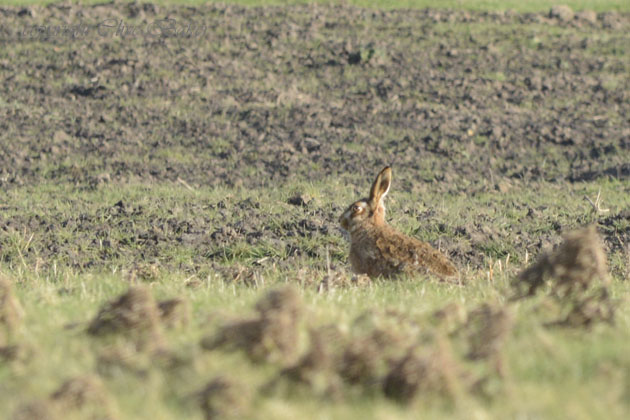
Lone Hare

Lone hare at home in the East Anglian Landscape

Early signs

There have been reports in the papers recently about wild plants being in flower early, the Botanical Society of Britain and Ireland held a four-day survey starting on New Year’s day and the result showed 368 species in bloom compared to 222 species last year, the figure for this time of year should be 30.

I can believe this as I have noticed a cowslip with flower buds opening in my garden this week, I also I saw my first snowdrop in flower on 28th of December.

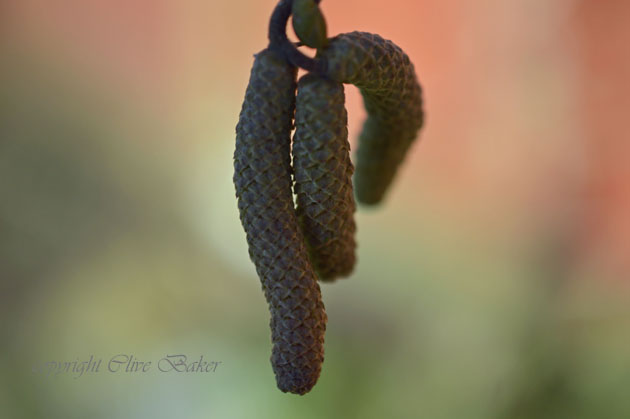
Yesterday I noticed lots of catkins out mostly hazel which is not unusual for this time of year as catkins are always the first to show, catkin bearing plants take advantage of the winds to pollinate and do this before other plants start to flower.

Three hazel catkins

Hazel catkin the ‘Male’ part of the plant

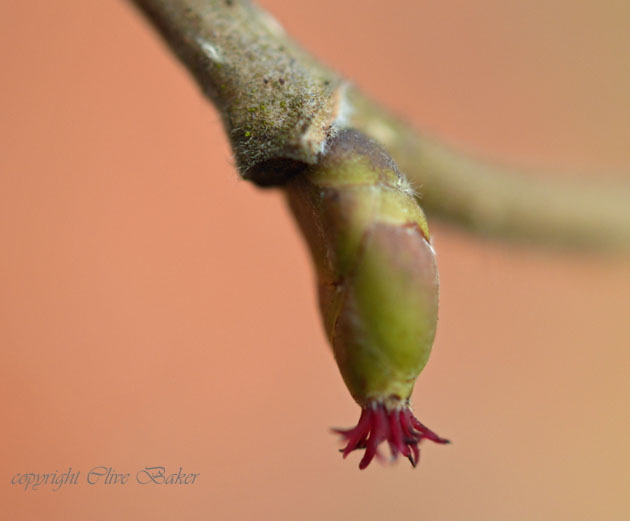
What I have noticed this year on the hazel plants is that there are a lot of the flowers, the female part of the plant, they are very small and you need to get really close to see them, these are the parts of the plants that catch the pollen from the catkins.

Very small red flower

Hazel flower the ‘Female’ part of the plant.

The other thing I have noticed is some of the hazel have green leaves on, which is very unusual for this time of year, I am not sure if they have opened recently or have managed to hang on over winter.

But next time you are out and about and you see lots of catkins, look carefully for little red flowers on the end of buds and you will be looking at hazel flowers.

Wassailing Time

Being twelfth Night (January the 5th) it is traditionally a time for Wassailing, also the night your Christmas decorations should be down as it is unlucky to still have them up after tonight.

Wassailing is thought to date back to Anglo-Saxon times maybe from an Anglo-Saxon toast Wæs þu hæl, meaning “be thou hale” or if you like maybe ‘Good Health’, wassail was actually a drink made of mulled ale, curdled cream, roasted apples, eggs, cloves, ginger, nutmeg and sugar.

There were two forms of Wassailing the house visiting and Orchard visiting, the latter seems to be more popular in the West Country, mainly Somerset, Devon,  Dorset, Gloucestershire and Herefordshire all the main cider producing counties, but of course East Anglia once had many orchards, most lost after the second World War due to more land being wanted for the growing of other crops.

The Orchard wassailing is where Slices of bread or toast were laid at the roots and sometimes tied to branches. Cider was also poured over the tree roots. The ceremony is said to “bless” the trees to produce a good crop in the forthcoming season.

I dare say there are many variations on this custom but I think the meaning and outcome is the same to bless the household and orchard with good health and wealth in the year ahead.

Good Health one and all.

A large crop of red apples

A good start to the year can produce good results later on

Testing the camera

Today I was back at WWT Welney, my first swan talk and feed of the year, despite the fog and frost there were a good number of people there, and there were quite a few birds to see, including a green-winged teal.

For this time of the year the water levels are low, last year we were having to wear dry-suits and use the floating wheelbarrow to do the feeds, but today nearly all the hides were open to the visitors, having said that it was very cold, so cold I decided to do all of the talk inside and not do any of the talk outside as I feed the swans.

But this gave me the chance to try out a camera on the wheelbarrow to try to capture the talk, so here is the result, there is a few seconds of darkness as I am in the tunnel to open the gate.

Bullfinch and Kingfishers

Today we had our local wildlife group new year walk around Ely, the forecast looked grim but it had stopped raining by the time we started our walk at 10:30 am, by the time we got down to the river we heard the call of a Grey wagtail as we looked for it a Kingfisher so at the same time we had two birds to look at Grey wagtail on the rail bridge and a Kingfisher on a branch by the bridge.

The sky looked dark but as we walked along the river we had a snipe fly over and land amongst the vegetation on the flooded meadow to our left soon to be hidden from view.

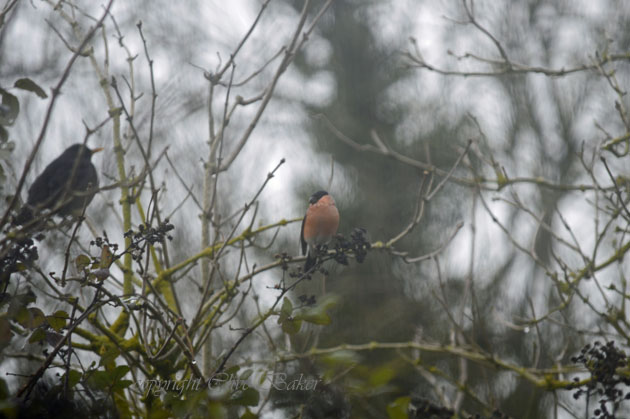
But the best spot of the walk was as the weather turned for the worse and the rain started to come down again we had a small group of four Bullfinch all appeared to be males but there may have been one female as most of the group showed us their white rumps as they flew in front of us, but at least two of the males allowed us to get close and see them in all their glory.

Bright red breasted male Bullfinch

A male Bullfinch allows us to get a close look at him

These are quite a handsome looking bird and in the Winter they tend to fly in groups, perhaps as more birds can look for food or maybe as there is little leaf cover at this time of year more eyes are better to look out for the odd Sparrow hawk on the hunt.

Same bird but closer

Closer look at the Male Bullfinch

It was raining quite heavy when I took these photographs of the Bullfinch so I was quite pleased they have come out well.

So a good start to the New Year with another 3 hour walk and 6 more birds added to the list.