As a child growing up in Suffolk Bishy barnabee was name we all knew the Ladybird by, and seems to be used in both Norfolk and Suffolk by most people when referring to them. You could actually live in Bishy barnabee way in Norwich or one of the roads off it like Ladybird way or Pollywiggle close, so at least it seems the name will be used in the future in one way if we were ever to stop using it in our everyday language.
But where did the name Bishy barnabee come from? There was actually a Bishop Barnaby who lived in the Fens and was apparently burned at the Stake so could this be a connection to the nursery rhyme which is said to have it’s origins in Norfolk “Bishy Bishy Barney Bee, Fly away home, Your house is on fire, And your children all gone”.
Another theory is the name is believed to be derived from the 16th century Bishop Edmund Bonner who lived from 1500 to 1569 , and was known notoriously as ‘Bloody Bonner’ for his ruthless persecution of Protestants under Queen Mary. Originally A vicar in East Dereham, Norfolk he became Bishop of London in 1539, so again another Norfolk connection.
One last Norfolk ryhme was used by Norfolk girls as the Ladybird was seen as a prophet of love and the young lady would hold the Ladybird in her hand and chant “Bishy, Bishy Barnabee do tell me when my wedding be”.

Whatever the origin of the name Bishy barnabee it seems to have a religious connection be it Bishop Barnaby or the fact that some say it was because the Catholic Bishops wore cloaks of red, the name Ladybird is said to come from ‘Our Lady’s bird’ referring to the Virgin Mary who was thought to always wear a red cloak and the seven spots on the ladybird were the seven joys and sorrows that the Virgin Mary was said to have embroidered on that red cloak.

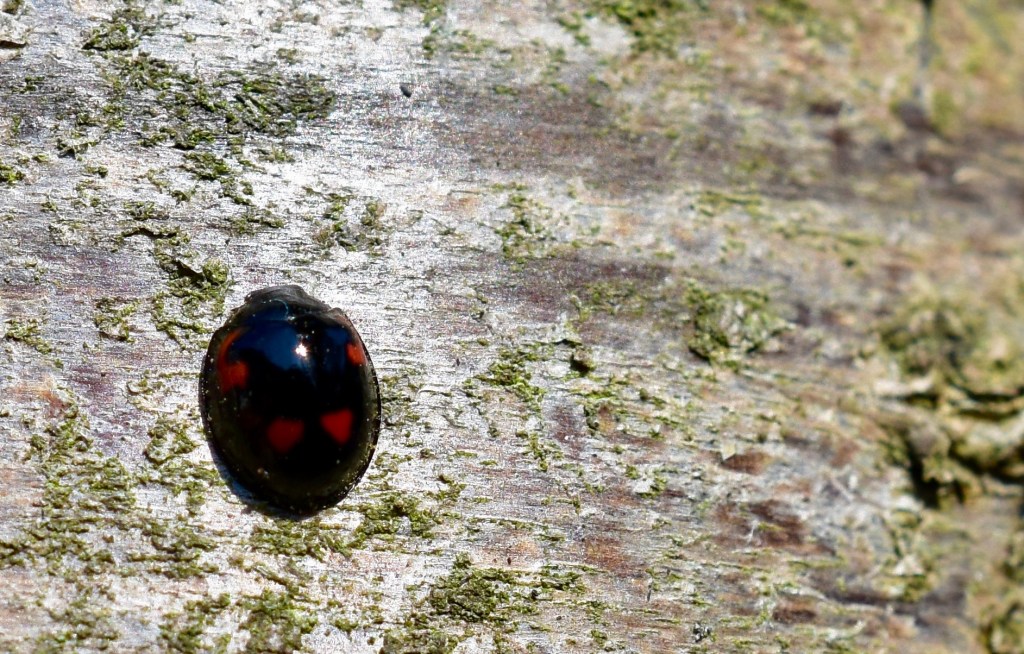
The connection to the Virgin Mary and her cloak with the seven joys and sorrows would make you think that there was only the one species (7 spot) Ladybird to be found in Great Britain and Ireland, but there are in fact 47 Ladybirds to be found in the British Isles, not all are Red and not all have spots, The 7 spot is the more numerous with 37129 recorded but it is decreasing, followed by the Halequin ladybird a recent addition to our British list from Asia with 34234 recorded and increasing, compare these two species with Nephus bisignatus with 1 recorded, all these records were from the BRC ladybird database for each species (ordered by number of 10km squares) from 1975 to 2015 which can be found in the fantastic book Field Guide to the Ladybirds of Great Britain and Ireland by Helen Roy and Peter Brown, this book gives you all the information you would want for identification of each species ( and you will be please to know all but a handful can be found in East Anglia ), on each species there is a colour plate page with the Adult, larva and a life size and some are tiny, and in case you were wondering Nephus bisignatus the length is 1.5mm-2mm and is black and the one record was in Rye Harbour, East Sussex in 1996.
References
Field Guide to the Ladybirds of Great Britain and Ireland, Roy, Brown and Lewington, Bloomsbury, 2018, ISBN HB: 978-1-4729-3567-0, PB: 978-1-4729-3568-7


 East Anglia the Wildlife, Landscape and People.