I am Back

DSCN8071

After a bit of a rest from the blog, I have decided to resume work on the page, so hopefully over the next few months I will de able to share more of my images from East Anglia (and a few from further afield) with you.

So watch the site.

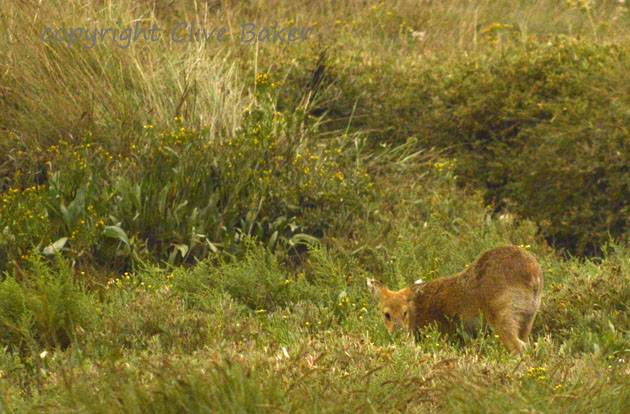
And as a start here is a Red deer I came across on a walk over Dunwich heath last week

View from the train

I am always amazed at what you can see when traveling by train, I am also amazed at what most of the other travelers miss.

Take this week on my 20 minute train journey from Ely to Cambridge I can get quite a total on my list, it is almost like traveling in  a mobile hide so far on Monday’s journey home I listed 1 buzzard, 12 roe deer, flock of fieldfares, 1 marsh harrier and 1 female merlin.

The following morning, two roe deer, 1 barn owl, in the evening trip home, roe deer and marsh harrier, this morning 1 buzzard, 1 barn owl, now take in to account it is only just getting light by the time we are approaching Cambridge in the mornings I am expecting the list to get better as the mornings get lighter.

I am sure there is more that I miss, but I always enjoy my train journeys as I can wildlife spot even if the train can be a bit packed.

Common Buzzard in Flight

Common Buzzard

Wicken Fen

Today I had a day off work an appointment in the morning but the afternoon was free, so I decided to have a walk around Wicken Fen, it was a dull day and the light was really low, but it is always a joy walking round what is the oldest nature reserve.

As I left the car park and walked down the track past the centre I could see lots of birds on the feeders, including a male and female mealy (common) redpoll the male already showing its breeding colours having a red tinged breast, slightly larger than the lesser redpoll which you are more likely to see in the Summer, I was lucky to see these two birds as there are usually only about 310 birds in the winter and only 3-4 breeding pairs in the Summer.

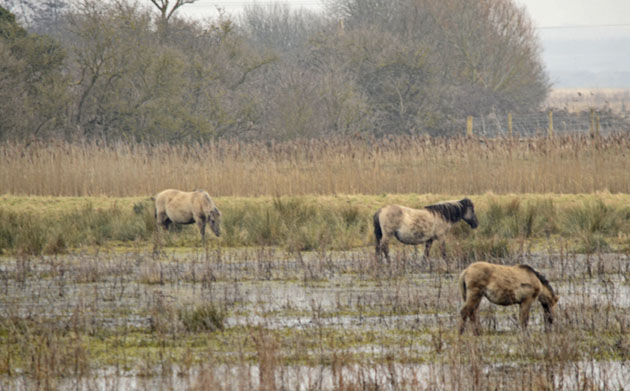
As I walked round the fen I was soon away from any walkers and regretted not wearing any gloves as it can get cold out here, I could see the Konik ponies on the fen, used here as they tend to feed on young trees and scrub and in doing so they are keeping the fen as it should be.

Threes ponies feeding in very wet conditions

Konik ponies grazing on the fen at Wicken

I stood and watched for a while and took in how quiet it was, no sound of Traffic only the wigeon whistling on the fen.

As I turned up the track I could see in the distance a Muntjac deer grazing on the track, there were more Konik ponies grazing in another field I stood here a while when suddenly a barn owl seemed to fly from nowhere, un seen by me it had been sitting on a low branch at the side of the field as when it had finished it’s hunting it returned there.
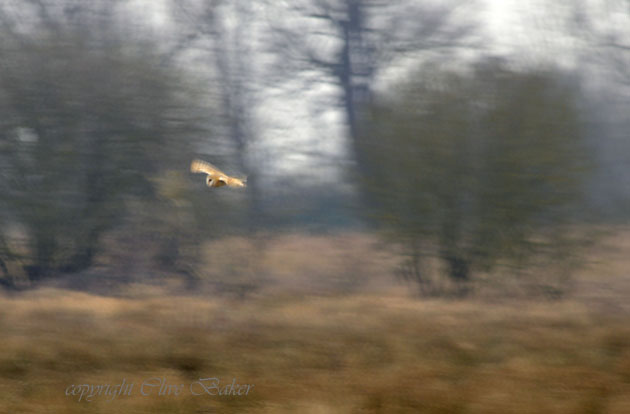
Barn Owl flying low over a field

the sudden appearance of a hunting Barn Owl

I watched the Barn Owl hunting for a while and decided to carry on up the track, The Muntjac was unaware of me and carried on grazing I managed to get close.
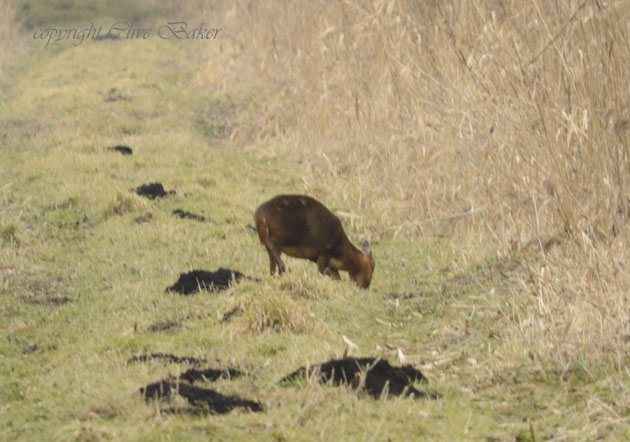
Small deer feeding on track

Munjac was unaware of me as I walked along the track

I wondered how close I could get, but all of a sudden it heard me and sprinted off up the track tail up and soon disappeared into the reedbeds.
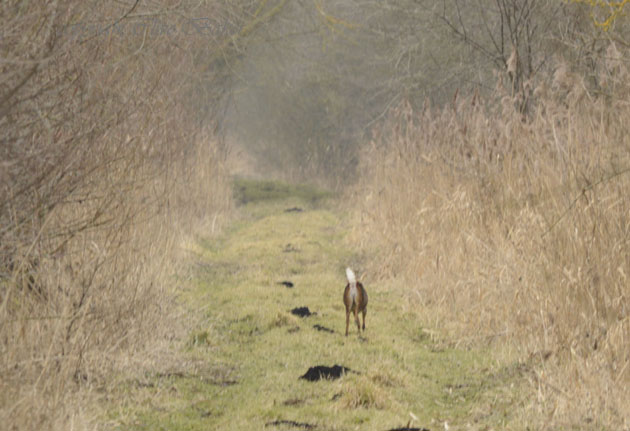
Deer running tail up in the air

The Muntjac takes flight

I was now turning back towards the main centre as I walked along Wicken Lode, but I could just make out something in the red beds in the distance and using my scope I could see a male Marsh Harrier sitting on a post turning its head looking from side to side the eyes not missing a thing, I watched him for a while until he flexed his wings once or twice then he took to the air flying over the reeds and away.

All in all for such a cold grey day there was lots to see, even if my hands were cold.


After the cold

After a week of ice, snow and sleet there were signs that we may be heading to a warm spell, the wind still has an edge but there seemed to be a lot of activity in the natural world.

Squirrels were digging up their hoards of  nuts buried in the Autumn and now easier to dig up as the frozen ground begins to thaw.

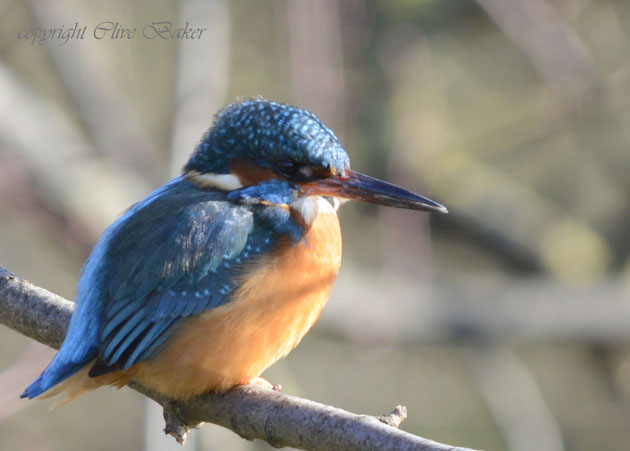
Kingfisher on branch

Kingfisher waits in the Winter Sunshine for a fish to pass by in the water below.

The Kingfisher has returned to the now unfrozen stream to catch fish that had been protected by the ice that had covered the water below.

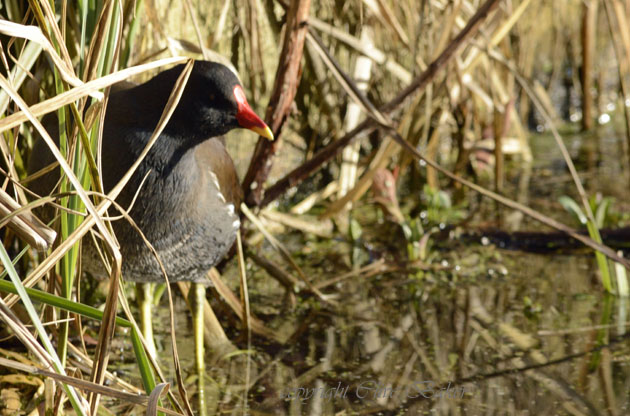
Moorhen on the edge of reeds

Moorhen in the reeds

The moorhens now patrol the reedbeds, their yellow and red bill brightens up the gloom of the reeds at it catches the sun.

Bird bathing

Song thrush washes itself in the stream

And birds like the Song thrush takes advantage of the water to have a bath in the stream.

If anything it proves how much the wildlife depends on water as we do for life and as the sun shines dare we start to think of Spring?


Hare today

Yesterday I was leading the Hare walk  at WWT Welney as a volunteer I usually do the guide in the hide, swan feeds and the hare walks.

I like the hare walks because you get to see the hares running around, boxing or just keeping low and making an escape when you are nearly on top of them.

The stronghold of the Brown hare is East Anglia as they like arable fields and you are more likely to see them running around the fields here.

But yesterday I saw a sight I have never seen before as I was leading a group of sixteen people round somebody said ” is that a bird of prey over there? ” as I looked in the direction they were pointing I could see it was, in fact I could tell it was a harrier, but as we were facing into the sun and we had a sighting at Welney of a male Hen harrier earlier, I needed to try to see if it was a Marsh or Hen harrier, I set up my scope to watch the bird and as it got lower and out of the sun I could see it was a Marsh harrier, then I noticed on the ground a hare feeding and the harrier was getting lower and heading for the hare, I wondered what was going to happen next as a hare seemed to big for a harrier to take.

The harrier landed on the ground behind the hare and the hare turned round and faced the harrier, they were nose to beak and just sat here in a face off, I could not take a photograph as my lens was not good enough and they were quite away off.

I do not know if this was a fairly young harrier or if the hare was a female and wondered if she should fight off the advances of the harrier but they just sat there staring at each other, they could still be there now!.

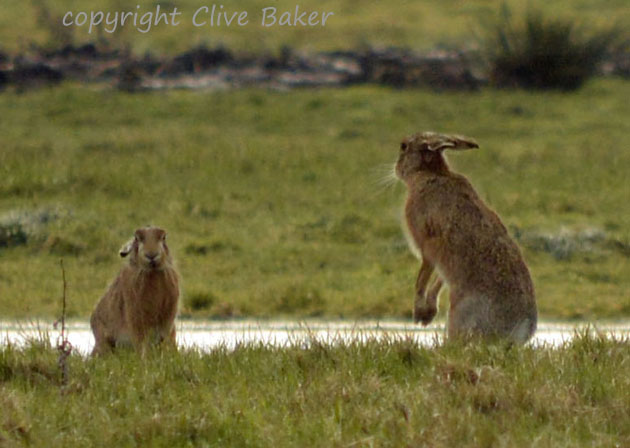
Hares staring at each other

A pair of hares facing off

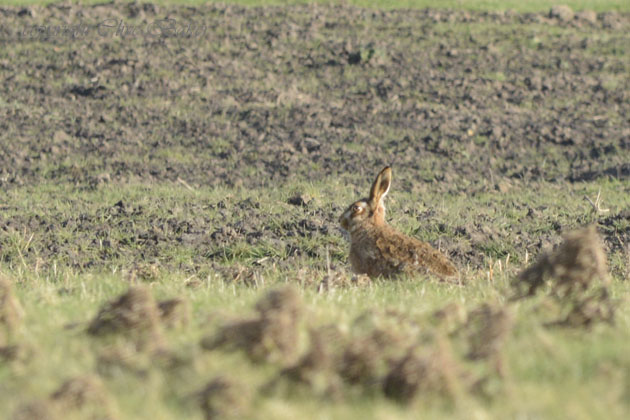
Lone Hare

Lone hare at home in the East Anglian Landscape

Something in the Garden at night

About two years ago I got myself a camera trap, triggered by movement it has an infrared beam that when broken will produce a still picture or can be set to video.

So far I managed to pick up Badger, fox, deer and rat when positioned in our small conservation area at work.

But the garden has produced quite different results, for example daylight has many images of collared dove, wood-pigeon, starling, house sparrow, border collie with ball and wife putting out washing all by daylight.

Night time has produced neighbourhood cats (around 6), mouse (maybe why we had so many cats) and best of all we discovered we had a hedgehog in the garden which was fantastic and these mammals are now in decline, main cause is road deaths as it’s only predator is the badger here in the UK.

Part of their diet is slugs, snails and insects so they are known as the Gardener’s friend, so we were delighted when we captured not one but two on video one night.

Sometimes Wildlife can be right under your nose

Nan birdwatching with seagull behind him

You can wait for hours and not see anything

Wildlife watching can be fun, be it bird or animal, sometimes you can wait for hours and see nothing, sometimes you are lucky and see things you did not expect.

When I lived in Lowestoft we would quite often get rare birds fly in from the sea, once I saw a Woodchat Shrike and a Rose coloured starling in 2 minutes only about 800 metres apart and this was only  after I overheard a man in shop say,  ” there are a lot of Twitchers down at the Bird’s Eye factory looking at a pink bird “.

I have heard stories of a Puffin on the river Ouse in Cambridgeshire, and a pod of Porpoises that swim up the river Nene as far as Wisbech on a regular basis ( I have seen the photographs ), more a surprise perhaps would be in the 1800’s when Whittlesea mere in Cambridgeshire was drained  the skull of a wolf and skeleton of a killer whale were found.

So As I always say it is worth keeping you eyes and ears open as you never know what will turn up.

The Common Hare?

The Brown Hare (Also known as the Common Hare) is very much an animal of the East Anglian countryside preferring the agricultural landscape, living out in the open from the moment they are born.

Everyone knows the saying ‘as mad as a March hare’ the month when the hares courting instincts are much in evidence, but the female or ‘doe’ is pretty much ready to mate from January which they do through to September, mostof the time the boxing you see in March is not always two males or ‘jacks’ fighting but most likely than not a doe fighting off the advances of a jack.

Two hares facing each other

Two hares face off

The young (leverets) are born covered completely in fur and fully mobile, unlike rabbits that are born, blind and naked in a burrow.

The Doe gives birth to the young in a group and then moves them one by one to a shallow depression or ‘form’ so they are split up, maybe to increase their chances of survival from predators such as foxes, stoats and now increasingly in East Anglia Buzzards.

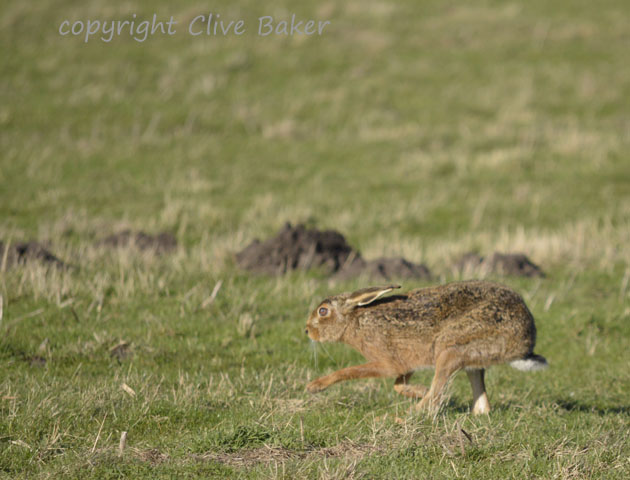
Hares will keep low on the ground keeping their long ears down low over their backs and will use their great speed to run away at the last moment.

Hare about to run away

A disturbed hare taking flight

Because of its antics the hare has  is steeped in folklore, with tales of witches turning themselves in to a hare to run away, and beliefs in parts of the country that a hare changing sex every month, even today we use expressions like ‘hare brained’ and ‘hopping mad’ so it is no surprise the name hare comes from the Anglo-Saxon word ‘hara’ which is to ‘jump’.

Living with Wildlife

Once every few weeks I give all the bird feeders and bird table a good clean with water and weak bleach solution to make sure there is no possible spread of disease amongst the feeding birds, after the news today regarding the case of avian flu in Yorkshire I may do this more often.

Yesterday after I had cleaned the feeders and allowed then to dry I filled them and hung them up again I heard a rustle in the ivy expecting to see one of the many house sparrows I was surprised to see a very damp looking woodmouse which had climbed  the ivy and was now eye level to me, I was not surprised to see the mouse as it and three others had been regular visitors to the bird feeders, I was surprised to see it as I had managed to catch three and release them in the fields and had not seen any for a while, now whilst I could quite happily live with woodmice in the garden, my wife said she could live with one maybe two and as we had seen four on the peanuts in one session of feeding themselves we decide to reduce our garden population.

Woodmouse eating peanuts on a birdfeeder

Woodmouse feeding on the peanuts

I was fascinated by how bold they were climbing up the ivy, then the honeysuckle to go from branch to feeder.

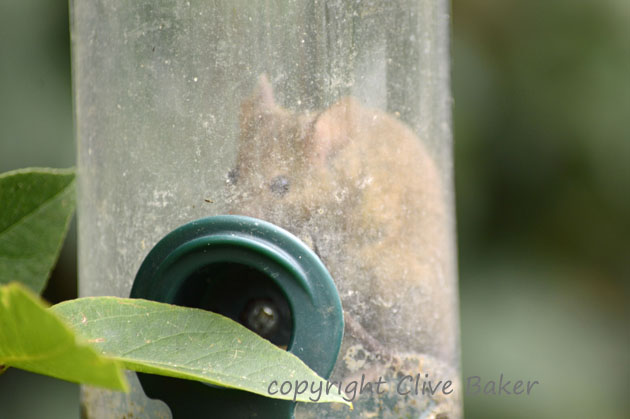
When I cut the honeysuckle back they started climbing the centre pole of the feeder to get to the feeders which hung from arms at the top, some would get about 4 feet from the ground fall off and climb back up,  I even found one had got into the feeder via the very small opening for the birds to get the seed.

Woodmouse in seed feeder

Woodmouse in seed feeder

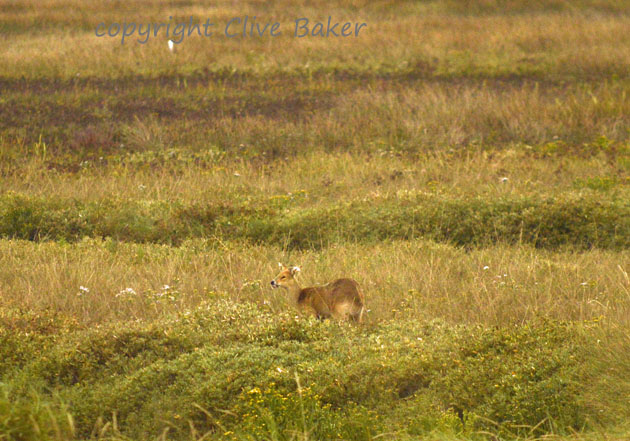
A larger mammal we had seen in September at RSPB Titchwell in North Norfolk was a Chinese water deer, it’s size is between a Muntjac and Roe deer, and 10% of the World’s population is in the UK, mainly in Bedfordshire, Cambridgeshire and Norfolk, after escaping from Whipsnade Zoo in 1929 the quickly adapted to  living in the British countryside.

Small deer on marshes

Chinese Water deer on Salt Marsh, RSPB Titchwell, Norfolk

So really it was a surprise to see one as bold as brass walking across the salt marsh feeding on the plants, they seem to love the wet habitat of the Cambridgeshire Fens and Norfolk Broads and like the woodmice in our garden I am happy to live with them in our countryside, although others may not.

Small deer feeding on grass

Chinese Water deer feeding on grasses, RSPB Titchwell, Norfolk